Full text
Archaeologists in Slovakia have uncovered a large Roman military camp likely used by Marcus Aurelius ' troops during conflicts with Germanic tribes in the late second century. The "extremely rare" camp came as a surprise to archaeologists, as it holds the hastily buried remains of numerous soldiers in unusual graves, including wells.
Remains of the 18.2-acre (7.4 hectare) camp were found near the town of Šurany in southwestern Slovakia, according to a translated July 17 statement from MH Invest, which excavated the area along with the Institute of Archaeology at the Slovak Academy of Sciences (SAS).
"We have a unique opportunity to explore practically an entire Roman marching camp, which is extremely rare in the European context," Matej Ruttkay , director of the SAS Institute of Archaeology, said in the statement. "We are clearly investigating a place that disappeared immediately after the military conflict between the Romans and the Germans."
Between A.D. 166 and 180, the Romans fought a series of battles against a Germanic people called the Marcomanni, who lived north of the Danube River along the border of the Roman Empire in what are now Slovakia and the Czech Republic. Marcus Aurelius, who reigned as Roman emperor from 161 to 180, commanded troops in the Marcomannic Wars with the goal of defending and securing Rome's border against barbarian invasions. But the wars ended upon Marcus Aurelius' death, when his son Commodus negotiated a peace with the Marcomanni, according to third-century Roman historian Cassius Dio .
The newly discovered Roman military camp had clear defensive characteristics, including five entrance gates, fortifications, and a curved ditch-and-rampart system typical of marching or legionary camps, according to the statement. The Šurany camp is only the second Roman military installation ever found in western Slovakia; the first camp, discovered in 2024 by SAS archaeologists, is thought to be where Marcus Aurelius wrote part of his Meditations .
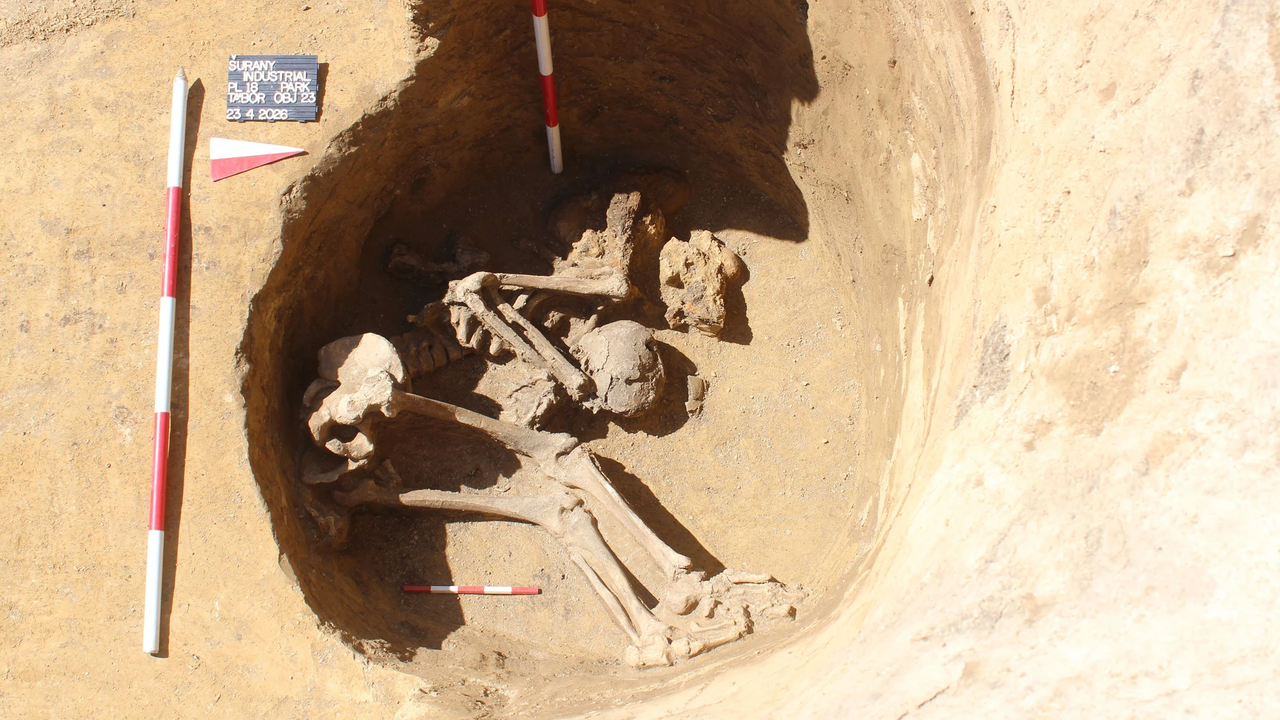
The Šurany camp surprised archaeologists with a large number of skeletons — and parts of skeletons — buried in ditches, wells and hastily dug shallow graves, according to the statement.
"Our preliminary findings indicate that in most cases these are Roman soldiers," Marek Vojteček , an archaeologist at the SAS Institute of Archaeology, said in the statement. "Numerous components of Roman military equipment and weaponry were also found with the skeletal remains, such as spears, arrowheads, parts of helmets, segmented and scale armor, legionary brooches, coins, and the characteristic ' caligae ' military sandals, from which iron nails on the soles have been preserved," he said.
X-ray analysis of blocks of clay revealed the intact sandal nails, which are now stored at the SAS Institute of Archaeology's specialized laboratory for further analysis. "It is literally a miracle to see the original footwear of a Roman soldier and even to be able to determine its size," Michal Cheben , an archaeologist at the SAS Institute of Archaeology, said in the statement.
RELATED STORIES
Lavish Roman villa discovered outside Rome's walls may have been frequented by Hadrian and Marcus Aurelius
Mass grave of Roman-era soldiers discovered beneath soccer field in Vienna
Archaeologists discover decapitated head the Romans used as a warning to the Celts
The unusual burials raise important questions about the use and abandonment of this Roman military camp, according to Cheben, including whether the soldiers died from combat injuries or disease and why the bodies weren't looted before being thrown into storage pits and wells . "Laboratory analyses and further genetic and anthropological research may provide answers," Cheben said.
Because the camp was so large and the artifacts so numerous, a comprehensive analysis of the site will take several years and will involve international experts in carbon dating, soil analysis, isotopic analysis and ancient DNA , according to the statement.
"This is a long-term process, so many results will only become known in the coming years," Ruttkay said.
From Augustus to Nero, see how much you know about ancient Rome's famous leaders with our Roman emperor quiz!
 🔬 Science
Ornate lead coffin found in Britain reveals burial customs of wealthy Roman women
Focus.pl · 24d ago
🔬 Science
Ornate lead coffin found in Britain reveals burial customs of wealthy Roman women
Focus.pl · 24d ago
 💡 Did You Know
Faces of 16 Roman-Era Residents of Budapest Reconstructed After 1,700 Years
Live Science · 1d ago
💡 Did You Know
Faces of 16 Roman-Era Residents of Budapest Reconstructed After 1,700 Years
Live Science · 1d ago
 🔬 Science
Archaeologists uncover Roman military camp and soldiers' remains in south-west Slovakia
Focus.pl · 2d ago
🔬 Science
Archaeologists uncover Roman military camp and soldiers' remains in south-west Slovakia
Focus.pl · 2d ago
Comments
No comments yet — be the first to weigh in 👇
No comments yet. Be the first!