Full text
During most times of the year, when you look up at a dark, clear night sky, the stars, planets, and perhaps the Moon shine brightly, along with if you’re lucky a view of the plane of the Milky Way. As far as objects moving through the sky go, you’re usually far more likely to see things artificial lights, like airplanes or satellites, than you are meteors. Across the entire sky, during most times of the year, you’re lucky if you can spot 2 or 3 meteor per hour: caused by random pieces of space debris, usually of cosmic (not human) origin, entering our atmosphere and combusting in a brilliant but brief flash of light.
Even though collisions with asteroids and comets are incredibly rare, there are several comets and asteroids that periodically cross Earth’s orbit: near-Earth objects, some of which can be quite large and massive. Over time, as they orbit around the Sun, these objects break up, and tiny pieces of debris — no bigger than dust grains — get stretched throughout the object’s orbit, populating it. Whenever Earth passed through that asteroid or comet’s orbit, even if the object is nowhere near, it runs into that debris stream at speeds of tens of thousands of miles (or kilometers) per hour, creating a spectacular array of streaking lights: a meteor shower.
This July, the Perseids have already begun, and conditions couldn’t be worse. But by the time the Perseid’s peak arrives on the night of August 12-to-13, we should be graced with ideal conditions for viewing, making 2026’s Perseids the best meteor shower of the year. Here’s why.
This time-lapse photograph shows several Perseid meteors all pointing away from the same area of the sky: the radiant of the meteor shower. A few stray meteors that don’t point back to that same location can also be seen: non-Perseid meteors captured by coincidence.
Credit : Adam Block/University of Arizona/Mt. Lemmon Skycenter
There are quite a few factors that determine how good a meteor shower is. While the density of the generating object’s debris stream (which determines the density of particles that make visible “shooting stars”) and Earth’s proximity to the debris stream’s center are the two biggest factors, there are plenty of others that don’t even depend on the intrinsic quality of the shower itself. They include:
the amount of cloud cover present at your location (none is best), and the quality of “seeing” in the sky (hazy skies are terrible, clear skies are perfect),
the amount of light pollution that’s present, caused by both the amount of terrestrial light generated by artificial sources on-or-near your location on the ground, as well as the phase and brightness of the Moon,
the hour of your viewing of the shower, as your views will be enhanced when you’re on the part of the Earth that’s rotating “into” the debris stream as opposed to the part that’s rotating “away from” the debris stream,
and how well the shower’s peak time — when Earth passes through the maximum density location of the debris stream during this current orbit — correlates to the quality of your viewing experience when and where you see it on Earth.
Right now, the shower’s peak time is still a long way away; we’re only passing through the faint outskirts of the comet Swift-Tuttle’s debris stream right now, and the Moon is waxing towards its full phase, where it significantly contributes to light pollution. However, the peak of the Perseids, slated for the night of August 12 and the pre-dawn hours of August 13, look like they’ll coincide with far superior conditions.
This current (as of July 21, 2026) wildfire and smoke map shows the severe regions of the United States, Canada, and other North American locations that are currently affected by 2026’s wildfires. The hazes and lower air quality is a severe problem not only for human lungs and safety, but for anyone seeking to observe the night sky successfully as well.
Credit : Airnow.gov
One of the big problems with viewing the night sky right now — at least, for many across North America and elsewhere in the world — is the large numbers of wildfires that are presently occurring. This doesn’t just generate cloud cover in the conventional sense, but hazardous hazes that don’t just reduce your ability to view the night sky, but your ability to breathe comfortably and safely while you’re outside. One of the great joys of a meteor shower is being outside and having an enjoyable experience; it’s pretty hard to do that when you can’t see upwards or even breathe outside without endangering your health!
Wildfires traditionally vary over the summer months, and are most intense in July and August, typically. Peak wildfire risks normally occur in the aftermath of the 4th of July weekend in the United States, with mid-to-late August typically having the worst wildfire smoke overall. However, there are usually peaks and lulls in wildfire season, and there’s no reason to think that today’s high levels of wildfire will continue unabated throughout the rest of the summer. Assuming we get a lull before the typical mid-to-late August cresting of wildfires, it’s reasonable to at least hope for good viewing during the peak night of August 12 and the morning of August 13.
This comet, imaged in 2015 and known as C/2014 Q2 Lovejoy, brightened sufficiently to become as bright as magnitude +4: visible to the naked human eye even under fairly light-polluted conditions. When Comet Halley returns, it will only be about 5-6 times brighter than this, but when Comet Swift-Tuttle next returns, it will be about 20 times brighter. Swift-Tuttle is far more massive and dangerous than the other known periodic comets. Although comets have been recorded for thousands of years, their periodic nature was only uncovered in the 18th century, by Edmond Halley.
Credit : John Vermette / MIT News
The parent body of the Perseids is the long periodic comet Swift-Tuttle, which completes an orbit around the Sun once every 133 years, on average. Because of its large perihelion distance, it’s one of the faster comets to create a meteor shower when it crosses Earth’s orbit. As a result, Perseid meteors tend to be very bright relative to meteor showers (like the Geminids or Taurids, for contrast) that have parent bodies with shorter periods and tighter orbits around the Sun. This is true even for small fragments of comet Swift-Tuttle, as even a low mass (small m ) meteor will have a large speed (a high v ), and hence a large kinetic energy, where KE = ½mv² .
Comet Swift-Tuttle has been in orbit around Earth for a long time, as the first recorded Perseids meteor shower dates all the way back from 1990 years ago, to the year 36 CE. At its peak, over 100 meteors were seen in just a single hour, which is similar to the peak of the Perseids for each of the nearly 2000 years to come afterwards. Although the greatest meteor productions coincide with the comet’s perihelion, it’s still consistent year-over-year, whether its close or far away in its orbit. In fact, the Perseids are the most consistent meteor shower across all of planet Earth, even though the comet itself, which last plunged through the inner Solar System in 1992, won’t return until 2126.
This time-lapse photo during the Perseid meteor shower shows more than 100 meteors in a single frame. Although most of the meteors point back to a single point of origin, the radiant of the Perseid meteor shower, about 20% of the visible meteors are strays, arising from other sources of dust in the Solar System.
Credit : Jeremy Perez, 2020
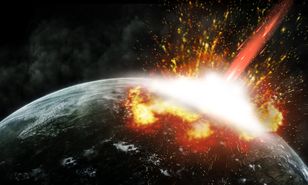
The parent body that spawns the Perseids, comet Swift-Tuttle, is in fact the single most dangerous known object to all of humanity, and to all life on Earth for that matter. Some 65 million years ago, an asteroid around 5-10 km in size struck planet Earth, and led to what we know today as the fifth great mass extinction, wiping out around 70% of all plant and animal species on the planet and driving the dinosaurs, flying reptiles, and much more to total extinction. Compared to that ancient impactor, comet Swift-Tuttle is both significantly more massive and also more energetic; if it were to strike Earth, it would release more than 25 times the amount of energy than the last giant impact our planet endured.
Due to Swift-Tuttle’s large, volatile-rich nucleus, each close pass to the Sun causes it to not only emit gases and ions, but to fragment and break apart ever-so-slightly. As tidal forces and heating lead to pieces of it breaking off, differential gravitational forces bring some tiny fragments ahead of it and others behind it in orbit. Over time, this stretches out into a collimated debris stream, with lots of particles spanning a wide volume of space surrounding the orbital path, but with the greatest density of particles occurring along the direct orbit of the parent body itself. When Earth passes through the center of that debris stream, the peak of the Perseids, lasting one night only, arrives.
Each year, Earth passes through the debris stream of various comets, including Comet Swift-Tuttle, which creates the visual phenomenon known as the Perseid meteor shower, and that of Halley’s comet, which creates two meteor showers: the Eta Aquarids and the Orionids. Although Comet Swift-Tuttle remains the single most dangerous object known to humanity, it’s Comet Tempel-Tuttle that has the honor of being the first comet linked to meteor showers (by John Couch Adams in the 1860s), being the parent body of the Leonids.
Credit : Ian Webster; Data: NASA / CAMS / Peter Jenniskens (SETI Institute)
This year, the peak of the Perseids is physically predicted to occur on August 13, 2026, at 2:53PM UTC, which corresponds to 10:53 AM EDT/7:53 AM PDT in the United States. In the hours after sunset, or before midnight, the Earth’s night side is rotating away from the planet’s motion into the debris stream, while in the hours before sunrise, or after midnight, the Earth’s night side rotates along with the planet’s motion into the debris stream. Therefore, for viewers in the Americas, the best time to view is after midnight but before 5 AM on August 13, while for viewers farther to the east — in Asia, Australia, and most of African and Europe — the better peak will be the next day: the pre-dawn hours of August 14.
The biggest variable factor on a year-to-year basis is typically the Moon. A waxing crescent moon is good, because once it sets (before midnight), the sky becomes clear and dark during the best viewing times. A gibbous moon (more than half full) is more difficult, because it emits more light and remains in the night sky for longer. A full moon is the worst option of all: bright and visible throughout the entire night, but the best scenario is a new moon, where it doesn’t pollute the skies with its light during the night at all.
This year, we’ll get those optimal conditions , as the new moon occurs on August 12, and so only a tiny, thin crescent will appear, setting rapidly after sunset, during the peak of the Perseids.
The Perseids, traditionally peaking between August 11 and August 13, are consistently the strongest meteor shower to recur year after year here on Earth. As sorted by their peak Zenith Hourly Rates, the Perseids are expected to be the top meteor shower of 2026.
Credit : Global Meteor Network
In recent years, the peak of the Perseids has led to what skywatchers call a ZHR — or Zenith Hourly Rate (how many meteors you can see per hour when the shower is at its peak and directly overhead) — that peaks at over 100 meteors-per-hour. This year, it’s expected that the maximum rate will exceed 150 meteors-per-hour and may even approach 200, owing to the ideal Moon conditions.
Additionally, the next-brightest objects in the sky are also in favorable configurations. In particular:
Venus, the brightest natural object after the Moon, is a post-sunset object, which will set roughly 3 hours after the Sun goes down.
Jupiter and Mars, also bright planets, are both close to the Sun, so won’t impact views during most of the night, not until shortly before the Sun rises.
Only Saturn, the faintest of all of the naked eye planets, will shine, but only contributing about the brightness of the 10th brightest star in the sky.
Once Venus goes down and midnight approaches, the Perseids will approach their most spectacular views. As Earth’s night side moves into the debris stream of Swift-Tuttle, the collision rate with the debris stream gets maximized, as does also the speed (and kinetic energy, and hence brightness) of the meteors. It’s a rare confluence of natural light pollution and the peak of a meteor shower coinciding in practically ideal fashion.
As they orbit the Sun, comets and asteroids typically break up over time, with debris between the chunks along the path of the orbit getting stretched out to create debris streams. These streams cause meteor showers when the Earth passes through that debris stream: with younger showers having more concentrated debris streams around the parent body’s nucleus and older showers having a more uniform debris stream. This image taken by Spitzer along a comet’s path shows small fragments outgassing, but also shows the main debris stream that gives rise to the meteor showers that occur in our Solar System.
Credit : NASA/JPL-Caltech/W. Reach (SSC/Caltech)
So how can you make the most of this year’s upcoming Perseids? Follow these simple viewing tips.
Find a clear, open space — with clear and dark skies, ideally — that allows you to view lots of the sky at once.
Turn off or block out all sources of artificial light that you can, as your eyes will dark-adapt more successfully if there’s no ambient light other than what the natural night sky provides.
Make a space for yourself to recline: not just to sit, but to sit at an angle or even lay down, so you don’t have to crane your neck up to see the sky.
Bring blankets, snacks, and drinks, as even in the summer months, it often gets chilly at night, and it’s worth it to be comfortable.
Don’t worry about a telescope or binoculars; you’ll want unmagnified, wide-field views. (If you’re into time-lapse photography, try a fisheye lens!)
Although you can easily find the central origin point, or radiant , of the Perseids by looking just below the leftmost stars in the famed “W” of Cassiopeia, meteors can appear anywhere on the sky and typically are spotted away from the radiant, so literally look anywhere except the radiant point itself.
Just be aware that the meteors that originate from comet Swift-Tuttle, the parent body of the Perseids, will all trace back to the location of that radiant in the sky. Even if you have no other information, “up” is generally the best place to look.
From the northern hemisphere, the Big Dipper, the North Star, and the “W” in Cassiopeia are all easily visible from even heavily light-polluted skies. If you can follow the imaginary line connecting the 3rd and 5th stars in the “W,” you’ll arrive at the point-of-origin of all Perseid meteors, known as the radiant.
Credit : E. Siegel/Stellarium
The way to maximize what you can see is to have dark skies and low levels of light pollution. Under those conditions, greater numbers of meteors are visible: especially including the fainter ones. Under a severely light-polluted sky, only a few dozen stars may be visible, even on a clear night. Under mildly light-polluted conditions, hundreds of stars will be visible, but not the plane of the Milky Way. Under the darkest skies of all, over 6000 stars can be seen over the course of the night, along with great detail within the Milky Way’s galactic plane. And in order to see a meteor, your eyes need to be able to pick out its brightness against all the other competing sources of light: difficult for faint meteors under heavily light-polluted conditions.
However, with dark skies, no Moon, and low levels of light pollution, it’s reasonable to expect a great show. There might be around 5-10 very bright meteors each hour the night of the peak, perhaps a couple of dozen modestly bright meteors per hour that are visible even with mild light pollution, but the majority (100+ per hour) of meteors will be the faintest ones of all, creating only brief streaks of light. Even without an outburst of meteors this year (they are hard to predict, and one is not expected), the favorable configuration of the Moon means that this year should see one of the best Perseid displays of the decade.
This photograph shows many Perseid meteors in the same frame, with a few stray meteors that arise from elsewhere. Satellite trails have been edited out of this photograph, and represent what an observer might cumulatively see over the course of several hours of observing from dark skies during the peak of the meteor shower.
Credit : mLu.fotos/flickr
However, the one thing that could ruin the experience no matter where you are is the bane of astronomers both amateur and professional alike: cloud cover. This year, it seems that wildfire hazes might be just as much of a problem as natural cloud, but we can still hope that by August 12-14, dependent on where you are, your skies will be haze free. Right now, the Perseids are far from their peak, the air quality is poor in many locations, and cloud/haze cover is severe. Additionally, there’s a visible Moon to contend with. But when the peak of the Perseids arrives, all of those condition might line up to produce a spectacular show: not just for you, but all across the globe.
The best part about the Perseids is that, no matter where on Earth you are, you’ll get to experience it for yourself from practically anywhere in the world. (Unless you’re too far north, within the Arctic Circle, and won’t have dark skies at all.) While much about the experience is unpredictable, including when and in what part of the sky, at your location, the greatest, most spectacular visual sights will arise, the one thing we can all share in is the sense of wonder and awe the comes along with seeing the natural wonder of the Universe for yourself, in real-time, with your own eyes.
This article 2026’s Perseids, lousy this July, will peak at the perfect time is featured on Big Think .


















Comments
No comments yet — be the first to weigh in 👇
No comments yet. Be the first!