BETA Technologies Unveils MV250 Hybrid-Electric VTOL Combat Cargo Drone at Farnborough
US defence company BETA Technologies unveiled the MV250, a hybrid-electric VTOL cargo drone, at the Farnborough International Airshow 2025 in England. The vehicle is a military adaptation of the company's civilian Alia 250 eVTOL aircraft, which can carry five passengers or an equivalent cargo load. The displayed prototype has not yet flown but is built entirely from flight-ready components, BETA Technologies confirmed.
Full text
A new hybrid-electric heavy-lift cargo drone has been unveiled by the defense arm of U.S. company BETA Technologies. The MV250 debuted in the static display at the Farnborough International Airshow 2026, taking place in England this week. The vehicle shown at the airshow hasn’t flown, BETA Technologies confirmed, although it is described as being built using “all-flyable components.”
The new drone is a military adaptation of BETA Technologies’ Alia 250 electric vertical takeoff and landing (eVTOL) aircraft, which can carry five passengers or an equivalent load of cargo, plus the pilot. TWZ and other journalists today spoke to officials from BETA Technologies at Farnborough.
Introducing MV250: a hybrid-electric VTOL aircraft designed to move critical cargo farther, faster, and at a lower cost.
MV250 builds on BETA's ALIA platform, integrating autonomy in an open architecture.
Read more here: https://t.co/wc7vIIOfsf pic.twitter.com/CEwURplqPl
— BETA Technologies (@BETA_aircraft) July 21, 2026
“The basic physics of the MV250 enable significantly longer range, higher speed, and a lower cost of operations when compared to tiltrotor and legacy platforms,” said Kyle Clark, founder and CEO of BETA Technologies. However, the claim that the MV250 exceeds the performance of a tiltrotor doesn’t stack up, based on published figures. “I believe we should be offering our military the most robust and best equipment in the world to maintain superiority and thus deterrence,” Clark added.
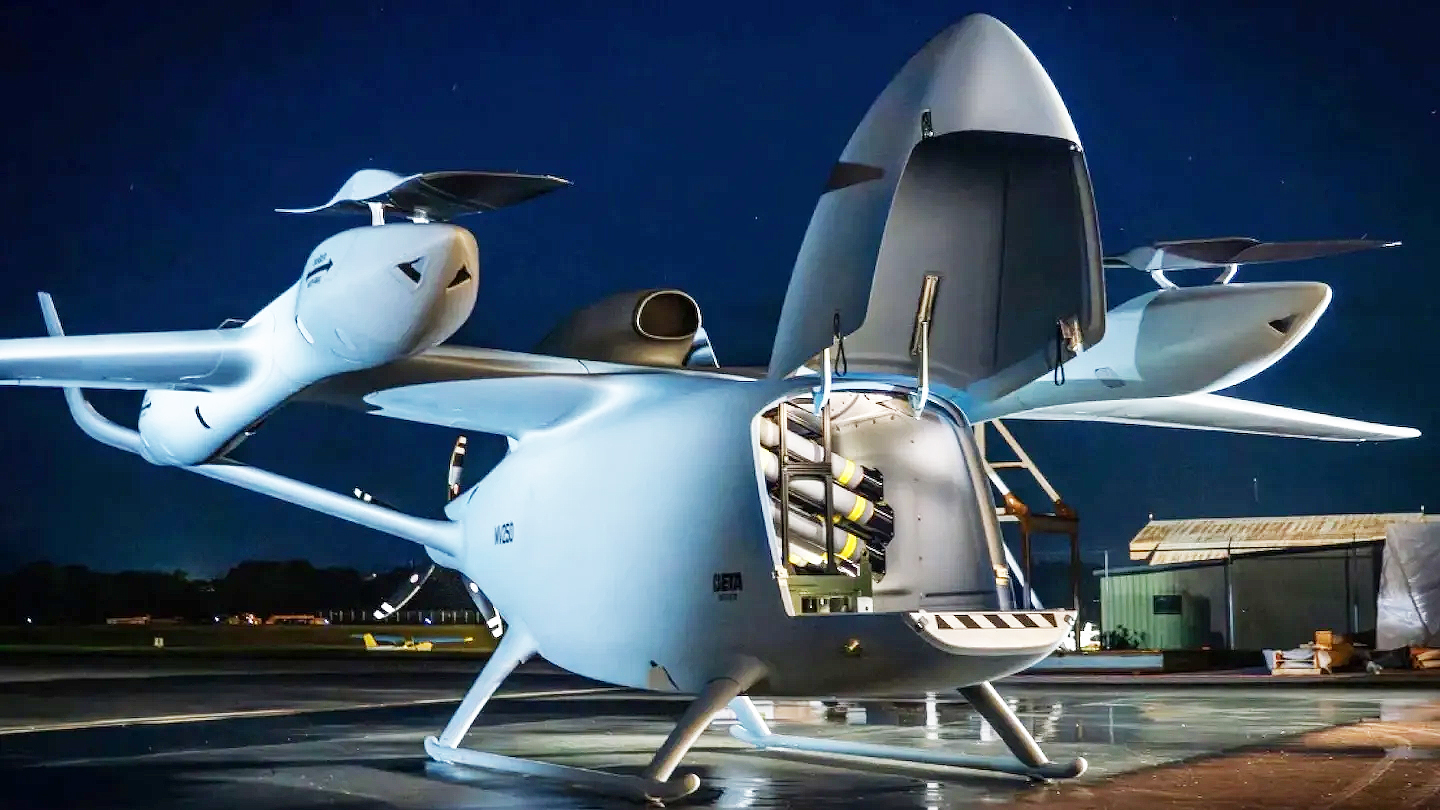
The uncrewed MV250 is primarily intended for cargo transport, with freight loaded and unloaded through an upward-opening nose visor. It can also deploy air-launched effects (ALEs) from a set of side-mounted launch tubes. A similar concept is currently being pitched by Sikorsky, with its uncrewed version of the Black Hawk helicopter , dubbed the U-Hawk, which is also intended to be able to fire dozens of ALEs, such as surveillance and reconnaissance drones and loitering munitions.
A pack of ALEs about to be loaded into the MV20. BETA Technologies
Other roles include casualty and medical evacuation, and intelligence, surveillance, and reconnaissance (ISR).
BETA Technologies has also proposed that the drone can be used as a forward-located tactical power source, providing up to 500 kilowatts to troops on the ground for command and control, counter-drone, electronic warfare, or directed energy weapon applications.
In terms of cargo capacity, the MV250 has a cabin volume of 250 cubic feet for a payload of 2,000 pounds.
The MV250 with its upward-opening nose visor raised to reveal the cargo area. BETA Technologies
Published performance specifications include an operational radius of more than 250 nautical miles, a cruising speed in excess of 170 knots, and a ferry endurance of 12 hours at 20,000 feet.
The propulsion system involves four fixed-pitch propellers which provide for the VTOL capability. These are mounted on long booms that connect the 50-foot-span wings with the V-shaped tail.
Meanwhile, forward propulsion is provided by a single variable-pitch pusher propeller mounted in the rear of the fuselage.
Since it has a hybrid-electric drive, the turbine engine — mounted above the rear fuselage — doesn’t directly power the various propellers. Instead, it directly feeds a high-voltage bus, recharging the batteries, and powering the electric motors that spin the propellers. The engine can also be stopped, and the battery can provide power, which is highly reliable.
A demonstration of the MV250 used as a forward-located tactical power source, here charging an electric motorbike. Jamie Hunter
The MV250’s turbogenerator has been developed with GE Aerospace and is compatible with a range of NATO-compatible fuels.
Proving hybrid-electric concepts in military aviation has long been a goal , as operators seek to harness the benefits promised by the combination of fuel efficiency, reduced emissions, and enhanced operational flexibility. The last of these points is reinforced by the reduction in the number of moving parts compared to more conventional configuration, including losing the traditional drive train, reducing the risk of component failure and easing the burden on spare parts and maintenance man-hours.
Hybrid-electric propulsion offers inherent advantages when it comes to reducing infrared and acoustic signatures.
The drone relies on Sikorsky’s MATRIX system to provide full autonomy. At a minimum, the MV250 should be capable of autonomously navigating along predetermined routes using programmed waypoints, establishing a practical baseline for uncrewed logistics operations. Beyond this, more advanced autonomous capabilities — such as dynamically replanning flight paths and responding in real time to emerging threats, obstacles, or changing mission conditions — would significantly enhance operational effectiveness, particularly during resupply missions in contested or high-risk environments.
Like other disruptors in the defense sector, BETA Technologies is looking to leverage its experience in the commercial realm to shake up the development cycles that the U.S. Army, Marines, and Air Force have previously relied on.
“Those organizations would wait years for external defense government funding to then build a very complicated and expensive, bespoke defense-only project,” Larry Smith of BETA Technologies said. “That typically will result in it being over schedule and over budget. Well, alternatively, what BETA is doing is using internal funding to rapidly create viable prototypes, not mockups, based on our commercial core technologies.”
Rear three-quarter view of the MV250 during its debut at Farnborough. Jamie Hunter
Also speaking today, Kyle Clark emphasized how BETA Technologies can use advanced design and manufacturing techniques to influence the speed and scalability of production. He described “a really thoughtful composites integration,” in which all the components are bonded using something much like “a big panini press.” Clark continued: “There are no fasteners in that fuselage, so we can make it inexpensively and meet the demands of the military. When the call comes and says, ‘Can you give us 600 of these aircraft?’ The answer is yes, and the cycle time is graduated in hours and not months.”
As an example of how the design and manufacturing process has been refined, Clark noted how the company went from 14,000 fasteners and 580 parts in the wing, to fewer than 300 parts and zero fasteners. Consequently, the manufacturing time was cut from six weeks to a matter of hours.
Although distinguished by its hybrid-electric propulsion system, the MV250 enters an increasingly crowded market for VTOL-capable cargo drones.
Established helicopter manufacturers also have a stake here, with conversions of existing crewed rotorcraft.
These include the MQ-72C Lakota Connector , which is stated to carry a maximum payload of around 4,000 pounds, including slung loads, and the Airbus U145 , adapted from the H145 light helicopter, with a payload of up to 2,600 pounds. You can read more about the MQ-72C in our previous coverage of that aircraft, here and here .
At @ILA_Berlin , we introduce the Airbus U145: an uncrewed, fully autonomous variant of the H145. Optimised for cargo with no cockpit, an integrated nose door, and full autonomy, its first flight is set for late 2026. https://t.co/MbodUxYxyI pic.twitter.com/2EnMXzog6c
— Airbus Helicopters (@AirbusHeli) June 8, 2026
At the smaller end of the scale is the R66 Turbinetruck , based on the proven Robinson R66 airframe, which can carry a load of 1,300 pounds internally, or external loads supported via a cargo hook. The Turbinetruck uses the same MATRIX autonomy system as used in the MV250 and others. In a similar category to the Turbinetruck is the Uncrewed 505, a development of the Bell 505 . Both those aircraft are set to be tested by the U.S. Marine Corps as that service seeks to field platforms that can rapidly resupply Marines in contested environments.
Based on published figures, the MV250 would seem to fall between the Lakota Connector and the U145 at one end of the scale, and the Turbinetruck and Uncrewed 505 at the other.
As for the Marines, they have been very much at the forefront of exploring the potential of uncrewed rotary-wing aircraft for use in future fleets of autonomous cargo drones. The Marine Corps considers uncrewed aerial and seagoing logistics “connectors” to be critical enablers of future expeditionary and distributed operations , particularly in a potential high-end conflict with China in the Indo-Pacific .
The U.S. Army is also looking at similar concepts, albeit currently at the larger end of the scale. Work includes optionally crewed and uncrewed versions of the H-60 Black Hawk series. The U-Hawk demonstrator, a fully uncrewed version of the Black Hawk helicopter , is intended to carry cargo and deliver launched effects and features clamshell doors in the nose . At the heavier end of the scale, Boeing has said its future plans for the H-47 Chinook include creating a path toward an uncrewed version of the aircraft .
However, these capabilities are also attracting growing interest from military services around the world.
Based on a commercial design, the MV250 — or a version of it — also has significant potential in the civilian space. Missions here could include disaster response and firefighting, but it would be equally well suited to cargo transport, particularly for remote resupply operations and logistics support to offshore platforms and isolated inland locations.
Overall, this is another example of emerging eVTOL capabilities bleeding into traditional rotary-wing defense segments, and we are likely to see much more of it in the future.
While the MV250 remains in the prototype stage, it reflects a broader shift in military aviation toward autonomous logistics platforms derived from commercial technology. As armed forces seek faster, more flexible ways to sustain distributed operations, aircraft like the MV250 could help redefine how cargo, supplies, and even combat capabilities are delivered on future battlefields, but it will also be entering an increasingly competitive marketplace.
Contact the author: thomas@thewarzone.com
The post MV250 Hybrid-Electric VTOL Combat Cargo Drone Unveiled appeared first on TWZ .
Will hybrid VTOL drones replace traditional transport helicopters?
Comments
No comments yet

















Comments
No comments yet — be the first to weigh in 👇
No comments yet. Be the first!