NASA Announces 2026 NIAC Award Winners for Innovative Mission Concepts
NASA has selected its 2026 NIAC Phase I awardees, including a concept to dim the Sun using a controllable dust cloud (DimSun) from NASA's Jet Propulsion Laboratory, and a Venus survivability mission called CANVAS. Other selected proposals cover gravitational wave detection and photonic space interferometry. The NIAC programme funds early-stage research into advanced future space mission concepts.
Full text
2 min read
Preparations for Next Moonwalk Simulations Underway (and Underwater)
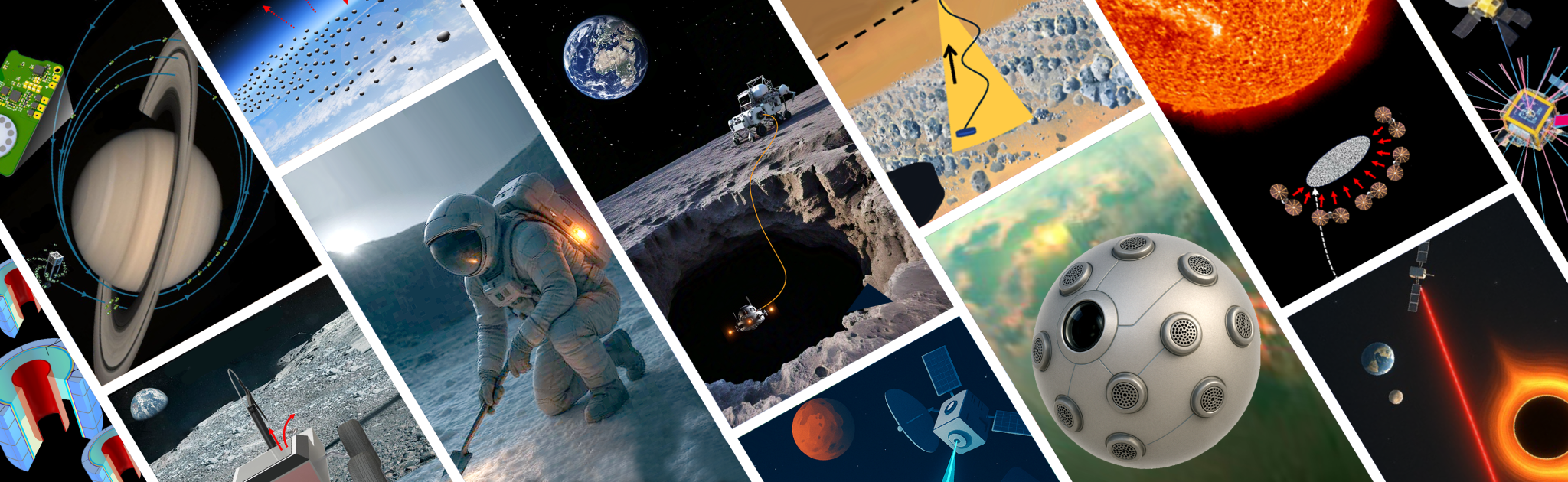
A collage of artist concepts highlighting the novel approaches proposed by the 2026 NIAC awardees for possible future missions.
NASA/Left to Right: Keunhan Park, Michael Rubenstein, Austin Phoenix, Benjamin Schafer, A.C. Charania, Gilly Elor, Pablo Sobron, Marco Quadrelli, Daniel Drew, Saptarshi Bandyopadhyay, Jeff Nosanov, Anish Damodaran
Phase I
Saptarshi Bandyopadhyay
Dimming the Sun (DimSun) Using Controllable Dust Cloud to Reduce Solar Insolation
NASA Jet Propulsion Laboratory
Pasadena, CA 91109-8001
2026 Phase I
David Bugby
Combinatory Architecture offering Neomobility, on-Venus Adaptability, and Survivability (CANVAS)
NASA Jet Propulsion Laboratory
Pasadena, CA 91109-8001
2026 Phase I
Anish Damodaran
PS21: Transforming Submillimeter Space Interferometry with Photonic Technologies
University of Central Florida
Orlando, FL 32826-2933
2026 Phase I
Artur Davoyan
Coilable Stacked Solar Sails for Very High delta-V Missions
University of California
Los Angeles, CA 90024-0001
2026 Phase I
A.C. Charania
EARENDIL: Extended Astronaut Radioisotope-EVA in Nighttime and Deep-space Icy Landscapes
Zeno Power Systems, Inc.
Washington, DC 20001-3701
2026 Phase I
Daniel Drew
Solid-state Propulsion for Autonomous Reconnaissance of Karst (SPARK)
University of Hawaii
Honolulu, HI 96822-2303
2026 Phase I
Gilly Elor
Power-over-Fiber to Enable a Lunar Underground eXplorer (LUX)
Stone Aerospace, Inc.
Del Valle, TX 78617-3017
2026 Phase I
Zhaoyan Liu
Quantum Wind Lidar Applications for Planetary and Earth Science Missions
NASA Ames Research Center
Moffett Field, CA 94034-0001
2026 Phase I
Jeff Nosanov
OBLIVIAN: Observing Black hole LIght Via Intensity cOrrelatioN
Orbital Velocity, LLC
Decatur, GA 30033-4151
2026 Phase I
Keunhan Park
Plasmon-Enhanced Radioisotope Thermophotovoltaic (PRTPV) Power Generation for Interstellar Missions
University of Utah
Salt Lake City 84112-1109
2026 Phase I
Austin Phoenix
ECLIPSE – Efficient variable Conductivity Lunar Insulator for Passive Surveyor Environmental Control
Virginia Polytechnic Institute & State
University, Blacksburg, VA 24060-5605
2026 Phase I
Marco Quadrelli
PRAXIS: Planetary Rings Autonomous EXploration with In-situ Sampling
NASA Jet Propulsion Laboratory
Pasadena, CA 91109-8001
2026 Phase I
Michael Rubenstein
Actively Steerable Femtosat Constellations for In-situ Exploration of Saturn’s Rings, Atmosphere, and Magnetosphere
Northwestern University
Chicago Evanston, IL 60208-0001
2026 Phase I
Benjamin Schafer
Photophoretic Tracers for Near-Space Remote Sensing at 30-100 km Altitudes
University of California
Los Angeles, CA 90024-0001
2026 Phase I
David Smith
Robotically Assembled Electromagnetic Metamaterials for Long-Range Space Situational Awareness
Duke University
Durham, NC 27708-9976
2026 Phase I
Pablo Sobron
Interworld Slingshot Resource Surveys
SETI Institute
Mountain View, CA 94043-5203
2026 Phase I
Paul Stankus
Mapping Alien Continents: Achieving Optical VLBI for Exoplanet Imaging
Brookhaven Science Associates
Upton NY 11973-0001
2026 Phase I
Paul Stankus
Precision Astrometry Using Optically Independent Spacecraft for Graviational Wave Detection
Brookhaven Science Associates
Upton, NY 11973-0001
2026 Phase I
Facebook logo
@NASATechnology
@NASA_Technology
Share
Details
Last Updated
Jul 21, 2026
Editor
Loura Hall
Related Terms
NIAC Studies
NASA Innovative Advanced Concepts (NIAC) Program
Research and Technology Mission Directorate
Keep Exploring
Discover More NIAC Topics
Space Technology Mission Directorate
NASA Innovative Advanced Concepts
NIAC Funded Studies
About NIAC
Should NASA allocate more funding to early-stage futuristic mission concepts?
Comments
No comments yet















Comments
No comments yet — be the first to weigh in 👇
No comments yet. Be the first!