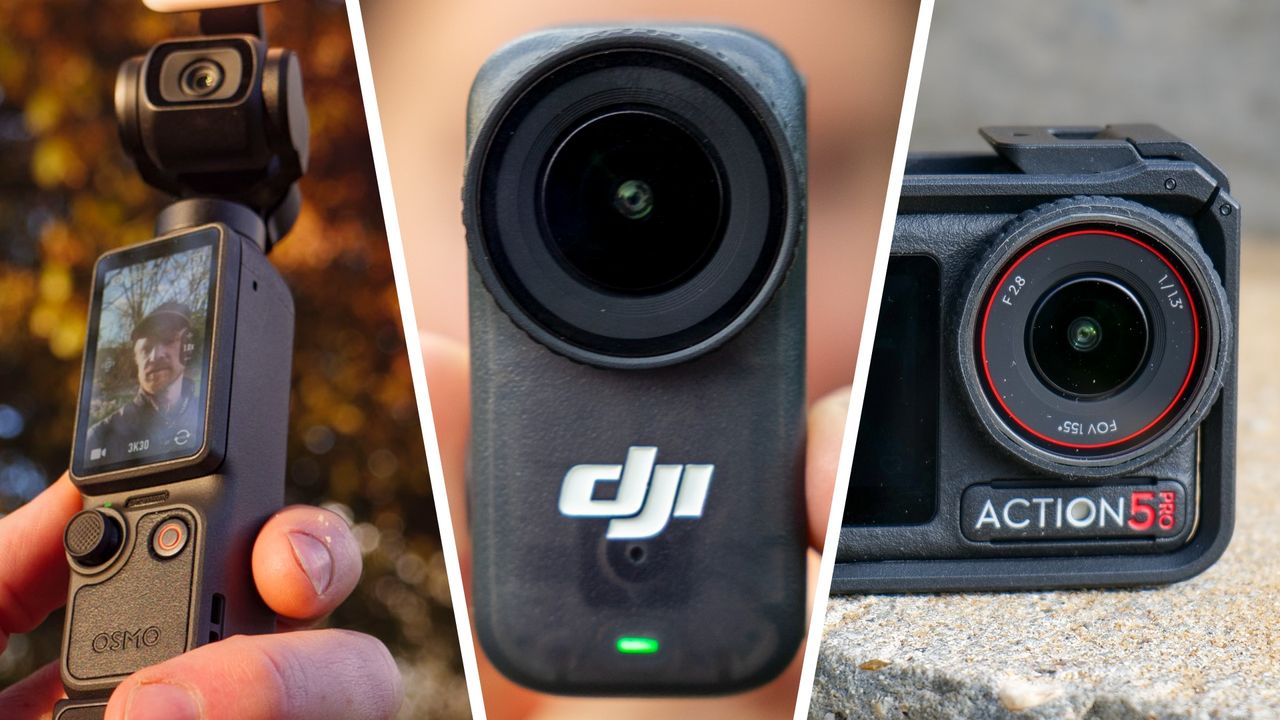
Which DJI camera to buy? Osmo Action, Pocket, 360 and Nano compared
DJI's compact camera lineup covers four categories: the rugged Osmo Action for action sports, the Osmo Pocket gimbal camera aimed at vloggers, the Osmo 360 for spherical footage, and the tiny wearable Osmo Nano. Each series targets a different type of content creator, from extreme athletes to everyday vloggers. The guide is based on in-depth hands-on testing of models across all four ranges.
Full text
Historically, the DJI brand has been all about drones. It remains an undisputed leader in that category, but in recent years its also solidified a name in compact cameras for content capture.
The two key ranges are the Osmo Action and the Osmo Pocket . The Action is DJI's classic action camera, with a rugged build designed to happily capture high-quality content no matter how much you bump, drop, submerge, freeze, or generally throw it about. The Pocket is a compact, image-stabilizing gimbal camera designed for vloggers. It can easily switch between vertical and horizontal shooting, and is set up to make selfie capture easy. There are also a couple of outliers : the Osmo 360 360-degree camera and the tiny, wearable Osmo Nano .
Most of these cams are leaders in their respective categories — this brand crops up in numerous best-of lists, including the best action camera , best 360 camera and best vlogging camera . If you're thinking of buying one but aren't quite sure of your options, or which to pick, you've come to the right place.
Our camera review team has tested every single one of the DJI cameras currently available to buy, and below you'll find a quick guide to the different models, plus summaries of our main testing takeaways, and links to read the full review for each (hit the More details button).
Note: You will only see cards for the products available to buy in your region. Due to FCC fun and games, not all new models are available in the US .
DJI Osmo Action
Osmo Actions are traditional action cameras — DJI's answer to a GoPro. They sport an all-in-one design, with all the hallmarks you'd expect from a good action cam: a robust, waterproof, compact design, front and back screens, mics, and features like time-lapse, slow-mo and (on newer models) subject tracking.
The current generation is the Osmo Action 6 , but the Osmo Action 5 Pro (there's no not-Pro version, so treat this like a naming quirk) and the Osmo Action 4 are widely available too, including direct from DJI. It's also quite easy to get hold of an Osmo Action 3 .
The specs and features differ slightly from model to model — you can see our review of each one by hitting the 'More details' button, and this DJI Osmo Action comparison page is useful for highlighting the differences.
You'll struggle to find either now, but the two previous models are the Action 2 and the original Osmo Action . The Action 2 was a particularly interesting swerve from DJI — it looked completely different from the rest of the range, with a modular build. For the third gen, DJI pivoted straight back to a more traditional all-in-one design, and that's what it's stuck with ever since.
DJI
Osmo Action 6
Read our full review
Pros
Larger 1/1.1-inch sensor
Great image quality
Impressive battery life
Expanding modular system
Cons
Aggressive in-camera processing
Fiddly accessory attachment point
DJI
Osmo Action 5 Pro
Read our full review
Pros
Good dynamic range and detail
Dual OLED screens
Waterproof to 20m without case
Long battery life
Works superbly with DJI Mic 2
Cons
No 5.3K+ video option
SuperNight mode is merely okay
DJI
Action 4
Read our full review
Pros
Much improved image quality
Wider FOV than the main competition
Excellent stabilization
Incredibly convenient mounting
Cons
Minimum 0.4m focus distance
Middling battery life
Old-school microSD card limits potential
DJI
Osmo Action 3
Read our full review
Pros
Incredibly convenient mounting
Best-in-class diving depths
Wider FOV than the main competition
Excellent battery performance
Handy front touchscreen
Cons
Poor lowlight performance
360-degree horizon leveling caps at 2.7K
Worse video quality than the best GoPros
Photography modes aren’t competitive
DJI
Action 2
Pros
Premium, smart modular design
Smaller than rival action cams
Class-leading horizon leveling
Wider FOV than Hero 10 Black
Punchy AMOLED display
Cons
Overheating limits clip length
Muted default color profile
Uninspiring low-light performance
Extra modules aren’t waterproof
No external audio source recording
DJI Osmo Pocket
Osmo pockets are compact, gimbal-stabilized 4K cameras designed specifically for vlogging. The current model is the DJI Osmo Pocket 4 — although it's not yet sold in the US. The Osmo Pocket 3 is still widely available to buy, as (to a certain extent) is the DJI Pocket 2 .
Both the 3 and 4 boast a compact design, excellent video stabilization, crisp 4K video, the ability to swap easily between vertical and horizontal shooting. The 4th gen version polishes things up a bit, improving the slow-mo mode, bumping up the video specs, tightening up the subject tracking and making it available in more modes, boosting battery life and increasing the internal memory. It also adds a magnetic gimbal arm, onto which accessories such as fill lights can be snapped.
If you're not quite sure about the Pocket range, another option for content creators is to stick with your phone for recording, but add in a DJI Osmo Mobile — a smartphone gimbal with advanced tracking capabilities.
DJI
Osmo Pocket 4
Read our full review
Pros
Very sticky subject tracking
More headline features available in more shooting modes
Built-in storage added
Attractive color profiles
Cons
Feels like a 'playing it safe' upgrade
Just 4K video, just a single camera
Can get warm when using the power-hungry features
DJI
OSMO Pocket 3
Read our full review
Pros
1-inch sensor
Bigger and better screen
Portrait recording option
Slow-mo mode now up to 4k at 120fps
Cons
Usability of touchscreen needs improvement
Can get hot when filming
No built-in storage
DJI
Pocket 2
Read our full review
Pros
The most pocketable, stable camera around
Creator Combo perfect for vloggers
Very useful tracking feature
Cons
Poor low light performance
Struggles with high-contrast scenes
Can get hot while filming 4K
Outliers
Finally, there are a couple of (as-yet) standalone DJI cameras. The DJI Osmo Nano is a shrunk-down and stripped back version of its Action series. Small enough to be mounted on a pendant or hat, it's designed for on-the-go content capture. The magnetic, modular design makes it nice and versatile.
The Osmo 360 is a DJI's first 360-degree camera, and we thought it was "undeniably extremely compelling" first effort. We were impressed with the pricing too, which is very competitive within that particular market.
DJI
Osmo Nano
Read our full review
Pros
Superb value
Onboard storage (64GB or 128GB)
Package is lighter than Insta360 Go Ultra
Good dynamic range and deep colors
Cons
Dock is only splashproof
Non-removable batteries
Interface is less intuitive than rivals
DJI
Osmo 360
Read our full review
Pros
Affordable price for premium performance
Works with DJI microphones
Built-in storage
Cons
Non-replaceable lenses
Not suitable for underwater video at launch
Comments
No comments yet















Comments
No comments yet — be the first to weigh in 👇
No comments yet. Be the first!