Full text
In looking back and commemorating the 50th anniversary of the Viking missions to Mars, one is struck by the bold and audacious undertaking.
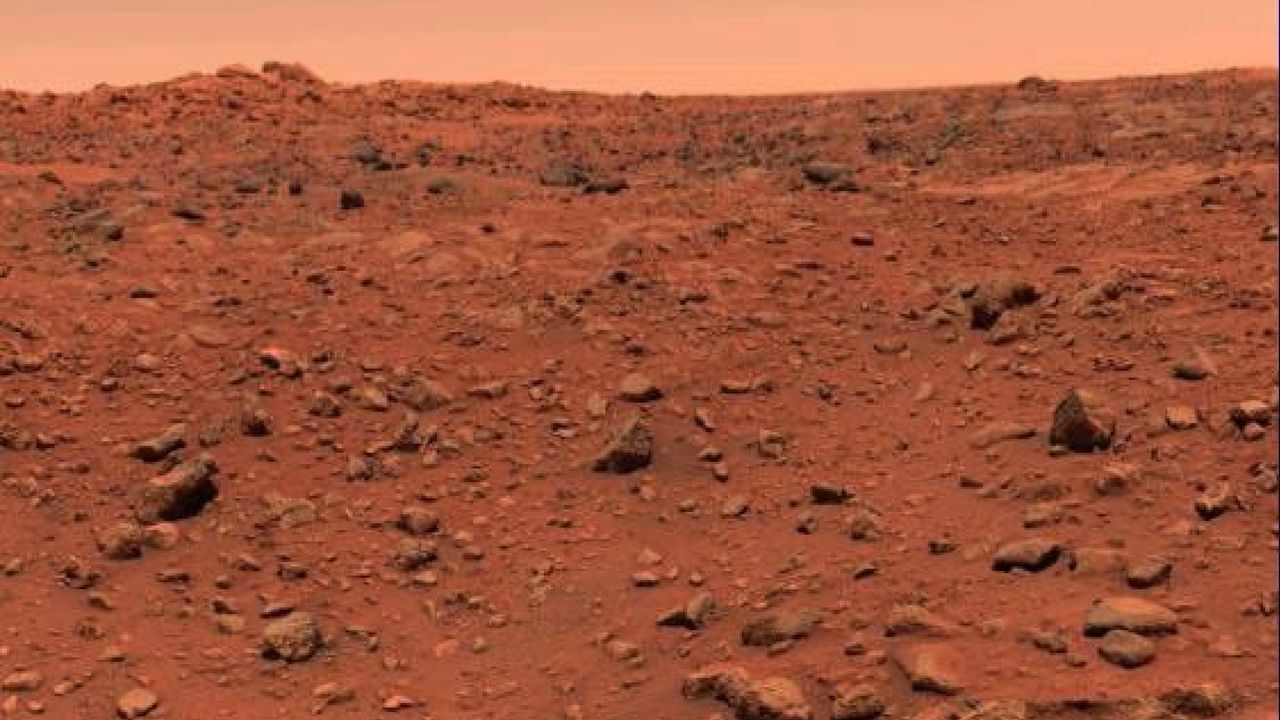
Twin spacecraft missions — each consisting of a lander and an orbiter — made their way to Mars and into the history books. The Viking 1 lander planted its legs on the terrain of Chryse Planitia 50 years ago today, on July 20, 1976, while its Viking 2 counterpart touched down at Utopia Planitia on Sept. 3 of that year.
Among their duties, the dual landers scooped up the first soil samples of Mars and deposited those precious collectibles into onboard, specialized equipment. Viking scientists had designed that gear to help answer an intriguing question: Is there life on Mars ?
A model of NASA's Viking 1 lander here on Earth. On July 20, 1976, the spacecraft touched down on the surface of Mars. (Image credit: NASA) One of Viking's instruments was a GCMS, a combination of a gas chromatograph (GC) and a mass spectrometer (MS). A positive GCMS detection could confirm the possibility that organics needed for the origin of life as we know it were present.
After interpreting all the data and information gleaned from ingested Martian soil, most scientists at the time concluded that Viking relayed a "no life on Mars" result.
But is it possible that the two robots actually radioed back a very clear comeback: "Can you repeat the question ?"
Different techniques
Ben Clark was a member of the Viking science team, and the instrument he designed made the first-ever measurements of the chemical composition of Mars soil. He is now a senior research scientist at the Space Science Institute in Boulder, Colorado.
"There were three life-detection experiments, each using different techniques to probe whether they could stimulate biological activity in the soil by adding various selected nutrients," Clark told Space.com. "Two were generally negative in their findings, but a third experiment had an expected strong response when it added nutrient."
Indeed, astrobiologist/inventor Gilbert Levin remained convinced that his Viking microbial detection instrument, called the Labeled Release experiment, did find living microorganisms in the soil of Mars. He held tight to that view until he passed in July 2021 at the age of 97.
Skeptical scientists
Clark recalled that many members of the scientific community were skeptical when geochemists pointed out that certain minerals can cause a similar response.
"Furthermore, when a second amount of nutrient was added, there was no additional response," Clark said. "Did the organisms die between experiments ?"
Because of these responses, and especially because no organic molecules could be detected, most biologists concluded there was no life in the dirt that Viking tested. "However, there is also the question of whether the best nutrients were used in the Viking tests," Clark noted.
Microbiologists who study the small organisms that live in Earth soil, Clark added, know that some species are extremely adept at using sulfate as an energy source, by combining it with organics or with hydrogen gas.
"Unfortunately, none of the Viking life-detection experiments added hydrogen gas to their chambers," Clark said.
"Ironically, the instrument which searched for organics in the soil, the GCMS, used hydrogen gas in its analytical technique," he added. "Thus, there was a tank full of hydrogen gas located just centimeters away from the life-detection experiment package, but no connection between it and the GCMS where it was located."
This mosaic is made up of more than 100 images captured by NASA’s Viking 1 orbiter, which operated around Mars from 1976 to 1980. The scar across the center of the planet is the vast Valles Marineris canyon system. (Image credit: NASA/JPL-Caltech) True positive detections?
Even today, there are some scientists who question whether some of the life-detection experimental results were in fact true positive detections, according to Clark.
"Other scientists believe that it was not enough to simply test the loose soil, but that life in fact may be just centimeters below the surface in areas where there is still ice in the ground ," he said.
Clark said that no other planet in our solar system so closely matches the early history of our own planet Earth.
"Recent discoveries by the rovers now roaming Mars have revealed some detections of organic molecules, and even some so-called 'reduction spots,' which are interpreted by some geologists as evidence of activity of biological organisms ," he said.
Misunderstood results
Steven Benner is an astrobiochemist and director of the Foundation for Applied Molecular Evolution in Alachua, Florida. He is author of the soon-to-be-issued "Meet the Neighbors: Life on Mars and How to Find It" (Penguin Press, 2026).
Benner has long argued that the results from Viking were misunderstood. He contends that the Red Planet remains an easily reached destination to discover a possible independent origin of life and draws upon the Viking records to spotlight how the scientific process has failed in this regard to date.
Tied to Viking's 50th anniversary, "I decided to write a grumpy 'take no prisoners' book that dispenses with politeness and focuses on the facts," Benner told Space.com.
Viking flyer from NASA Langley Research Center. The spacecraft were built by Martin Marietta with Langley in Hampton, Virginia managing the Viking project. The Jet Propulsion Laboratory handled the operations of the probes once in flight. (Image credit: Langley Research Center/The Viking Mars Missions Education and Preservation Project) Misbegotten consensus
Benner said that his new book highlights two tales.
"Viking more likely than not found autotrophic microbial life on Mars, roughly 1,000 cells per gram — about what you might expect based on Earth analogs," said Benner.
The other story, he said, is that communities will defend a misbegotten "consensus" long after that consensus ceases to be defensible. They should not be beholden to a half century of mistakes, he emphasized.
The GCMS misinterpretation was 100% of the grounds for dismissing considerable life-positive data, according to Benner. So, he said, "we should then have gone back to the status quo ante, as Gil Levin did. But since 'consensus' in science is powerful, and Levin was polite, the community marginalized him."
Viking preservation
Rachel Tillman is the founder and executive director of the nonprofit Viking Mars Missions Education and Preservation Project .
Her late father, James Tillman, worked on Viking 1 and 2 and was a professor in the Department of Atmospheric Sciences at the University of Washington.
"There are a variety of reasons it's important to preserve Viking data," Tillman told Space.com. Archiving how and why things were done on Viking from an engineering standpoint is vital, she said, as is safeguarding the science data accumulated during the Viking program.
"Science is dynamic. Instruments and missions are finite in what they collect, so every data is part of a growing body of knowledge coming in pieces of a much larger puzzle. We can't complete the puzzle without all of the data," said Tillman. "So every facet of Mars science is a tiny piece of the puzzle. For that reason, we need to keep all the pieces."
This is true of every engineering success and failure, she added.
"Our organization has records on both. Because of that, we can help industry reduce costs by making the archives available on failed tests as much as successful ones," Tillman said.
It takes many, many missions to get close to answers we theorize on, she pointed out. "And then there is inspiration. By preserving the past — the who, what and how — we inspire youth and the public to support endeavors and even join the workforce," she concluded.
Space technicians prepare the Viking 1 lander, encased in its bioshield, for its sterilization. (Image credit: NASA) Contaminate and confuse
"The entire Viking mission — orbiters and landers — are one of the most important sets of data about the planet Mars," said Barry DiGregorio, an honorary research fellow for the Buckingham Center for Astrobiology in the United Kingdom. He is author of "Mars: The Living Planet" (Frog Books/1997).
"Indeed, the Viking biology data have become more important today than they were during the Viking mission," said DiGregorio. "Because Viking carried the very first suite of extant biology instruments to Mars, extreme care was given to the extensive heat sterilization protocols for the Viking landers."
Those protocols ensured that the Vikings did not carry large numbers of terrestrial microorganisms that might contaminate and confuse the actual soil sample results in its three onboard life-detection instruments, DiGregorio said.
Warning flag
However, DiGregorio is also waving a warning flag.
The recent discovery of never-before-detected extremophile microbes in spacecraft assembly clean rooms has made it important to take planetary protection protocols to a new level, said DiGregorio.
"Unfortunately, the search for extant life on Mars has been made much more difficult by unwittingly sending Earth's hardiest extremophile microorganisms there for the last 30 years," he said.
If Mars life is indeed spotted, extra effort will be required "to make sure it isn't earthly extremophile microbes we are detecting," DiGregorio added.
Both Viking landers ceased operating more than four decades ago. But they could still aid the Mars life search today, according to DiGregorio. Perhaps, he said, "comparing any new data found with archived Viking Lander biology data will be crucial in determining their interpretation."



















Comments
No comments yet — be the first to weigh in 👇
No comments yet. Be the first!