Full text
Nowadays, the word "weapon" may evoke modern-day technologies such as firearms, blades and missiles. Yet archaeological evidence shows that weapons have existed for hundreds of thousands of years. Of course, early humans wielded weapons that looked quite different from those used today.
So what is the oldest weapon?
Generally, weapons are defined as objects used to impart violence on other living beings, said Ben Fitzhugh , a professor of anthropology at the University of Washington in Seattle. That includes objects used in interpersonal conflict among hominins (a group that includes modern Homo sapiens and our relatives that evolved following the split from chimps and bonobos) and for hunting, Fitzhugh told Live Science .
Sign up for our newsletter
(Image credit: Marilyn Perkins / Future) Sign up for our weekly Life's Little Mysteries newsletter to get the latest mysteries before they appear online.
But archaeologists don't automatically consider just any object that could cause harm to be a weapon; context and intent matter, Rolf Warming , founding director of the Society for Combat Archaeology and a doctoral candidate in archaeology at Stockholm University, told Live Science in an email. For instance, experts excavating a site with potential weapons might look for evidence of hunting, such as butchered animal bones ; or artifacts like pointed bone tools that can be used to craft weapons. They may also consider what objects were made out of and residue or wear marks on the weapons themselves, which can help determine how they were used.
According to Warming, archaeologists generally consider three finds as contenders for the oldest evidence of weaponry in the archaeological record: the Clacton spear, the Schöningen spears and throwing sticks, and the Kathu Pan 1 spear points.
Clacton spear
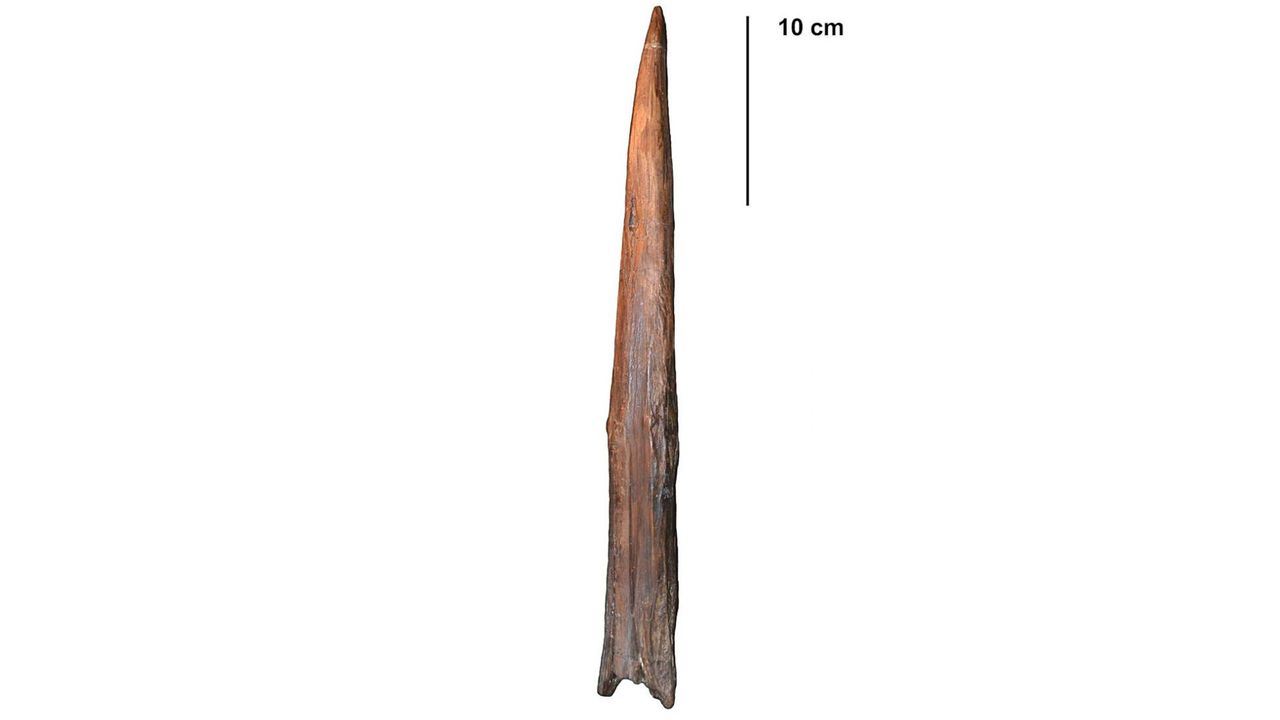
Scientists have estimated that the Clacton spear is over 400,000 years old. Experts think the uncovered 15-inch-long ( 37 centimeters ) spear point was broken off from a longer shaft, perhaps by accident while the user was hunting, or deliberately as a ritual . It's made from yew wood and was worked with a tool to a sharp point on one end. The broken end was never found.
Excavated in 1911 from Clacton-on-Sea in Essex, England, the Clacton spear is now on display in London's Natural History Museum , where it is labeled as the oldest preserved wooden spear fragment in the world.
Archaeologists believe it was fashioned by either Homo heidelbergensis or Neanderthals — two hominins that predate H. sapiens . In fact, the spear appears to be older than our species, as the oldest known H. sapiens fossils date to around 300,000 years ago . The Clacton spear's shape, size and wood suggest that it was a thrusting weapon and that its makers engaged in cooperative hunting strategies.
Schöningen spears and throwing sticks
Different views of a throwing stick from Schöningen, a contender for one of the world's oldest weapons. (Image credit: Photograph by Volker Minkus) Since 1992, archaeologists have excavated between 20 and 25 wooden weapons at a site in Schöningen, Germany , including complete and fragmented spears, and throwing sticks made predominantly from spruce and pine wood .
They're considered the oldest completely preserved wooden weapons in the world , according to the Schöningen Research Museum; today, archaeologists' varying estimates place the weapons' age between 200,000 and 300,000 years old. Their creation has historically been attributed to H. heidelbergensis , an early human species that lived about 700,000 to 200,000 years ago throughout Europe, parts of Africa, and possibly in what is now China. More recent dating suggests the spears could potentially be the work of Neanderthals, according to a 2025 study .
Scientists think these spears, which average just over 6.6 feet (2 meters) long, were used as thrusting weapons, throwing weapons or some combination of both to hunt larger game mammals, like horses, according to a 2024 study . The shorter throwing sticks are believed to be projectile weapons and average around 26 inches (65 centimeters) long.
"In fact, the [Schöningen weapons] were found in association with butchered horses," Fitzhugh noted. The spears were sharpened, hardened and blackened using fire. "These things were shaped in a dynamically sophisticated way," he said.
According to Warming, the Schöningen weapons suggest hominins had clear material knowledge and used different hunting tactics depending how far they were from their target.
Kathu Pan 1 spear points
Hafted spear tips — stone points attached to some form of handle or shaft — became more common in the archaeological record between 200,000 and 300,000 years ago across Africa and Eurasia, and were previously thought to be created by Neanderthals or H. sapiens .
However, 500,000-year-old stone points excavated from the Kathu Pan archaeological site in South Africa have signs of wear on the edges, and the shape of their base is consistent with hafted spears, suggesting they were used as weapons. Their age predates both Neanderthals and H. sapiens , and the location they were found in suggests they could have been created by H. heidelbergensis, who lived in regions of southern Africa at that time . Archeologists think they could have been used as spear ambush weapons .
But some researchers have contested this evidence, arguing that it's " indirect " or even controversial , as no wooden shafts were uncovered with the spear points to solidify them as weapons as opposed to stone tools.
Something older?
Related mysteries
Has there ever been a period in human history without war?
Were the Vikings really that violent?
Did Roman gladiators really fight to the death?
These are some of the earliest examples of weapons in the archaeological record, but there may be older weapons that have not survived throughout time.
While hominins likely used organic materials like wood, sinew, fiber and adhesives to create objects and weapons, these materials break down or are destroyed over time, Warming noted.
Studying these ancient weapons gives us perspective about the present. After all, weapons are more than tools of harm: Warming said they are material clues that give us glimpses into how our early relatives combined materials, used their imaginations, shared knowledge and cooperated in groups.
Yet among these three important finds, Warming said that when inquiring about the oldest known weapon in the world, that "Clacton is the safest answer."
Can you identify these historical objects of war? Test your smarts with our weapons of the world quiz!

















Comments
No comments yet — be the first to weigh in 👇
No comments yet. Be the first!