Full text
Two defense technology companies filed lawsuits in federal court Tuesday after being excluded from the U.S. Navy’s newest unmanned surface vessel acquisition program .
Blue Water Autonomy and Saildrone allege they were kicked out of contention for the Navy’s Medium Unmanned Surface Vessel Family of Systems program after the Navy failed to comply with its own requirements, among other errors.
Blue Water Autonomy said the decision was based on “overly restrictive evaluation criteria, a misreading of Blue Water’s proposal, and irrational conclusions that are inconsistent with the [Request for Prototype Proposals] and statutory requirements,” according to a complaint filed in the U.S. Court of Federal Claims.
A significant portion of both companies’ legal documents were redacted, and the specifics of what the Navy found lacking in each of their MUSV proposals was not immediately clear.
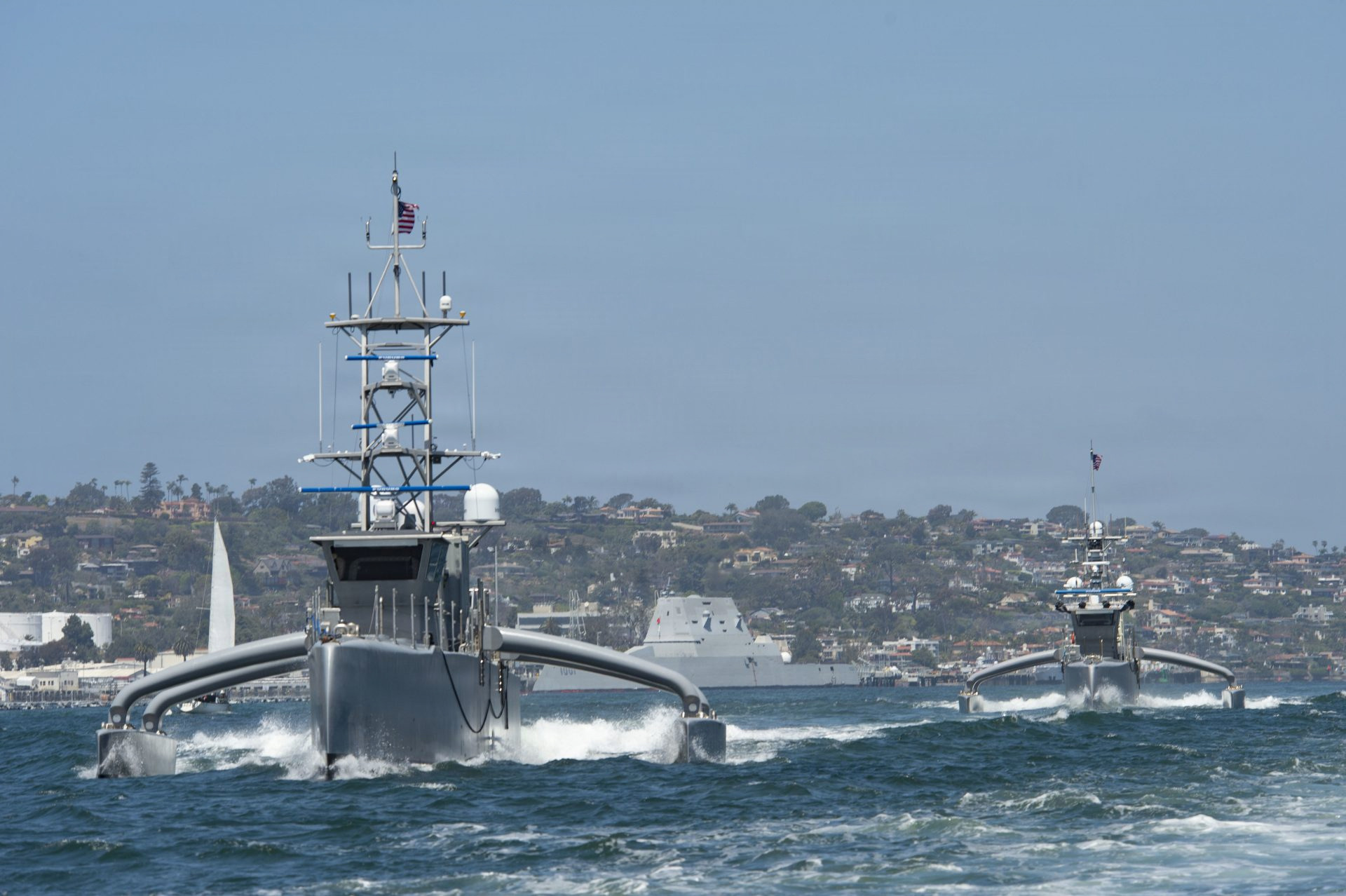
The Navy launched the MUSV program and opened solicitations for the new class of boat on March 26, after canceling the Modular Attack Surface Craft program.
The latter, announced on July 28, 2025, solicited the development of USVs that were capable of carrying large containerized payloads that could accommodate a similar weight to the Navy’s anti-ballistic missile system, the Mark 70 Mod 1 Payload Delivery System.
The MASC program was dedicated to a specific mission and specific ask from the fleet, whereas the MUSV program addresses a larger batch of requirements and mission types.
This was the reasoning behind the shuttering of the MASC program, according to Rebecca Gassler, portfolio acquisition executive for the U.S. Navy’s robotic and autonomous systems.
The MUSV solicitation, which ended on April 17, analyzed a company’s business plan, manufacturing plan, test plan and technical design.
Chosen companies and their MUSVs were then instructed to prepare for an on-water test with a surrogate vessel that would be conducted at the end of the fiscal year.
Blue Water Autonomy was initially chosen by the Navy to participate in the Modular Attack Surface Craft program before the MUSV program was rolled out.
The company was already underway in developing its Liberty vessel for the MASC program when it ended, having sunk money into production.
But before Blue Water Autonomy could participate in the on-water test with a surrogate vessel to demonstrate its viability as a partner for future MUSVs, they say they were barred from continuing in the MUSV program competition.
The Navy announced on June 1 that it had selected seven companies to participate in at-sea testing.
Those companies included Sea Machines, Leidos, Saronic Technologies, Galliano Marine Services, PacMar Technologies, Birdon and Huntington Ingalls Industries.
Blue Water Autonomy was not on the list.
US Navy selects companies for at-sea MUSV prototype testing
The company said the Navy’s decision to remove it from consideration for the MUSV request for prototype proposal was “capricious” and not “in accordance with statute or regulation.”
The complaint asked that the Navy halt the testing and funding for the MUSV program until “prejudicial errors” were remedied and Blue Water Autonomy was allowed reentry into the program in an effort to win the bid for the MUSV contract.
Saildrone was also excluded from participating in the program after initially taking part.
The company argues that it was more than deserving of being in the mix for the MUSV program, as it operates the world’s largest fleet of contractor-owned, contractor-operator USVs which have completed upwards of 2.5 million nautical miles since 2012, according to a complaint filed in the U.S. Court of Federal Claims.
“Our fully compliant MUSV submission to the US Navy should have qualified for advancing to the next round, in which we would participate in sea trials and develop a prototype at our own cost,” a Saildrone spokesperson said. “We support the Navy’s mission and believe there has been a misunderstanding in the evaluation of our bid.”
Saildrone has deployed more than 70 vessels across the globe, including for the Navy and U.S. Coast Guard, the complaint said.
The company said it learned it was disqualified from continuing to compete in the MUSV program from a news article and was offered no explanation in an email follow-up with the U.S. government as to why it wasn’t given an opportunity to continue.
Eventually, Saildrone says they were provided a “fundamentally flawed evaluation.”
“Because advancement to the on-water test event imposes no material financial obligation on the government, reevaluating Saildrone’s proposal consistent with the solicitation and advancing Saildrone furthers the public interest at no meaningful cost,” the complaint said.
Saildrone asked to be reinstated in the competition and allowed to compete in the on-water test.
The fiscal 2027 Navy budget calls for the procurement 63 unmanned vessels .
President Donald Trump’s One Big Beautiful Bill Act contains $2.1 billion for medium unmanned surface vessels, a Navy official told Military Times in March.




/https://tf-cmsv2-smithsonianmag-media.s3.amazonaws.com/filer_public/4e/ef/4eef342c-0f1c-48ce-a941-bfb64c516a24/screenshot_2026-07-16_at_20301pm.png)





Comments
No comments yet — be the first to weigh in 👇
No comments yet. Be the first!