An American poet's work is literally being sent to the Moon
A poet who grew up during the space age, with a father who worked in the space industry, describes his lifelong fascination with the Moon. One of his poems will be physically sent to the Moon as part of a space mission. He describes himself as a "lunaphile," someone irresistibly drawn to the Moon since childhood.
Full text
In some sense, I’ve been going to the Moon most of my life. As a child of the space age whose father worked in the space industry, I’ve tracked sometimes closely, sometimes less so with activities in space. Satellites, the space race, men on the Moon, and all the sci-fi and commercial kitsch that went with it was part of growing up in the sixties. Even now, I pay attention to the night sky, not only in terms of the burgeoning space industries, but to the sky itself, and most definitely to the Moon. That’s sort of going, right?
It’s hard to explain the connection I feel to it, something nurtured in me since I was very young, like trying to explain why I love peanut butter. But it’s more than just a taste. Maybe you could call me a lunaphile, someone hopelessly attracted to the Moon as if I were a tide locked to its pale, changeable gravity. I find the Moon’s comings and goings familiar, comforting, inspiring. Almost a persona. Though it’s thousands of miles away, seeing the Moon grounds me. And not just me.
Since human beginnings it has been our common heritage owned by no one, shared by all peoples. An emblem, an oracle, a myth. In spite of multinational plans to forge settlements and roads and fueling stations, dig mines and tunnels, build nuclear reactors, and encircle it with satellites and internet connection, I want the Moon to remain what it has always been. Something that unites us. Something whose beauty and mystery draws and inspires us. Life sustaining. Our moon. Everyone’s moon.
Is the Moon destined to become an interstellar gas station, a resource to be mined and sold? Who gets to decide? At a truly transformational moment in human and cosmic history, we can’t afford to look away.
Three years ago, I began to write a book about going to the Moon. However, I’m not an astronaut, not even an astronomer. I can guarantee you that I will never step foot inside a spacecraft caged within its cramped compartment with another human—or three—anticipating an explosive liftoff, never hurtle through space traveling at 25,000+ miles per hour for a minimum of three days in said cramped compartment bumping weightless against my fellow astronauts, their streaming hair, eating from reconstituted pouches, and drinking my own recycled urine.
Not breathing fresh air, not being able to stand, walk, or open the door and get out before at last reaching lunar orbit about 238,000 miles away from that miniscule blue dot far in the distance: Earth, my home. I will certainly never orbit above the beautiful but desolate lunar surface waiting to attempt a landing, hoping it will be successful. I won’t have to imagine what becomes of a human body, mine, left—or vaporized—in outer space.
“ Moon !” I called out to it, like an old friend staring back.
Three years ago, I knew what everyone in the world already knows about the Moon just by looking at it, its shapes, sizes, faces, colors, phases, times of appearances. Its constancy. I wasn’t going to write about any of this. The Moon is older than humankind and has been observed and recorded from prehistory. People don’t even have to see the Moon to know such things. You can look at a calendar or the weather app on the phone in your pocket. Or do a quick online search. Plus these days, an AI assistant could conjure everything you’d want to know in minutes. With illustrations. Or video. No one needs the actual object anymore to know as much as they want to about the Moon.
But I’d recently discovered that one of my poems would be included as part of the Lunar Codex, etched on nickel nanofiche, and sent to the Moon in a time capsule. It would travel by rocket and land on the lunar surface where it will remain forever. While I wasn’t going to the Moon in the regular sense of that phrase, the poem—something I’d made and a reflection of myself—was going. It felt awesome and as close as I’d ever get.
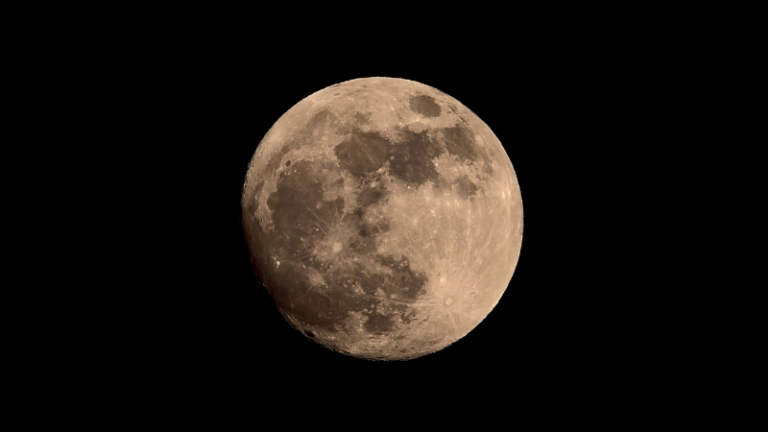
This past November, I went outside to watch the full moon rise. The “Beaver Moon,” as NASA advertised it, lifted up from behind the houses across the street, magnificent, full and profound. I watched it push through gauzy cloud, shimmered silver, etched. Huge. Marvelous. “ Moon !” I called out to it, like an old friend staring back. Even though I knew my iPhone wouldn’t capture a decent picture, I couldn’t help it. I took one anyway. I always try. Like a poem, a picture is another way of remembering, of trying to capture the ephemeral, recover a fleeting moment. And the Beaver Moon appears only in November, just once a year.
Then, as now, I also looked for Mare Crisium, the “Sea of Crises.” When viewed from Earth it’s a big, darkened splotch near the full moon’s far right edge. Somewhere in that huge basaltic plain my poem and the Lunar Codex successfully landed in March 2025. Yeah, it’s up there. So weird. Wonderful, but . . . weird. As much as I wanted to keep taking it all in, I couldn’t just stand out there staring at the Moon all night, though I did watch for many long minutes before going back inside at last. I didn’t keep track of the time.
But I can keep count. China claims to be well on the way to putting people on the Moon by 2030, less than four years away. Not to be outdone, our current administration subsequently released an executive order to get people back up there by 2028. As I write this, four brave humans have returned to Earth after soaring around the Moon, NASA’s first crewed mission in fifty-four years. While China’s space program has been more focused and overall successful to date, it remains to be seen which country will get back on the lunar surface first.
Either way, with only 12-13 full moons per year, there may now be fewer than 52 more uninhabited full moons left to see. If so, only four of those will be Beaver Moons, if you think about it.
I do.
__________________________________
Going to the Moon by Sally Ashton is available from Duke University Press .
Does sending literary works into space have genuine cultural value?
Comments
No comments yet












Comments
No comments yet — be the first to weigh in 👇
No comments yet. Be the first!