Full text
U.S. President Donald Trump has threatened a strike on a very hardened Iranian facility known as Pickaxe Mountain, saying it is ripe for “nice big fat shot right in the front door.” Trump’s comments underscore the challenges involved in holding this extremely deeply-buried site, which is tied to Iran’s nuclear program, at risk. The installation notably went untouched during the Operation Midnight Hammer strikes on Iran in June 2025, and was not struck in the course of Operation Epic Fury this year, either. So, here is what Pickaxe Mountain is, why it matters, and why it would be so hard to destroy.
Trump spoke about Pickaxe Mountain, also known as Kuh-e Kolang Gaz La, during a phone interview yeterday with Huge Hewitt on the Salem News Channel network . This came amid renewed fighting between the United States and Iran, which broke out last week and has continued to escalate. The regime in Tehran has now declared the highly strategic Strait of Hormuz closed again to all maritime traffic, while the U.S. military is moving to reimpose a blockade of Iranian ports. This is all despite the signing of a 14-point Memorandum of Understanding (MOU) last month that included the extension of an already fragile ceasefire . Readers can get caught up on the broader situation in the Middle East with our recent reporting here .
"You've obliterated 3 of their nuclear sites, but they got a 4th site, maybe, at Pickaxe Mountain. Before you enter into another deal, will you insist that IAEA inspectors get down into that deep, deep, deep tunnel…?" @POTUS : "Absolutely. They don't have it because we have… pic.twitter.com/ywaTZEB2Tm
— Rapid Response 47 (@RapidResponse47) July 13, 2026
“Before you enter into another deal, will you insist that IAEA [International Atomic Energy Agency] inspectors get down into that deep, deep, deep tunnel and find out if they got a doomsday machine down there?” Hewitt asked Trump during their conversation yesterday.
“They don’t have it because we have eyes with Space Force, and everything else. We have a lot of eyes on it [Pickaxe Mountain],” Trump said in response. “But Pickaxe is a possible target for a nice big fat shot right near the front door, and I think that maybe you’ll see that.”
“We see no activity there. They’re not doing well with their nuclear situation. Every time we hear about it, we blow it up. So they don’t like talking about it,” Trump added. “But we’ll probably give Pickaxe a shot relatively soon.”
What is Pickaxe Mountain?
It should be noted here up front that there are actually assessed to be two independent tunnel networks under Pickaxe Mountain. One was built circa 2007, and the construction of the other began around 2020. The entire complex, which is contained within a single large security perimeter, is situated immediately to the southwest of Iran’s nuclear facility at Natanz, as seen in the satellite image we obtained from Vantor below. As an aside, Natanz was one of the facilities that U.S. forces struck during Operation Midnight Hammer . Natanz and Pickaxe Mountain are roughly in the center of Iran.
A satellite image showing entrances to the newer site at Pickaxe Mountain, as well as a view of the immediate surrounding area. Satellite image ©2026 Vantor
The enrichment facility at Natanz is seen here at upper right. Pickaxe Mountain and its sprawling perimeter are seen just below and to the left. The entrances to the older site, built circa 2007, can be seen at lower left. Satellite image ©2026 Vantor
A map giving a general sense of the location of Natanz and Pickaxe Mountain within Iran. Google Maps
In the past, Iran has openly discussed plans to produce centrifuges to support its nuclear enrichment efforts at the newer facility at Pickaxe Mountain. It is also estimated to be large enough to house an actual enrichment plant, as well as other nuclear infrastructure, but exactly what is inside remains unconfirmed . Hewitt’s question yesterday reflected the fact that international inspectors have not been given any access to the overall site to date.
In light of strikes on other Iranian nuclear sites since last year, there is also the possibility that Iran may have relocated nuclear assets from other facilities to the more extensively hardened ones under Pickaxe Mountain.
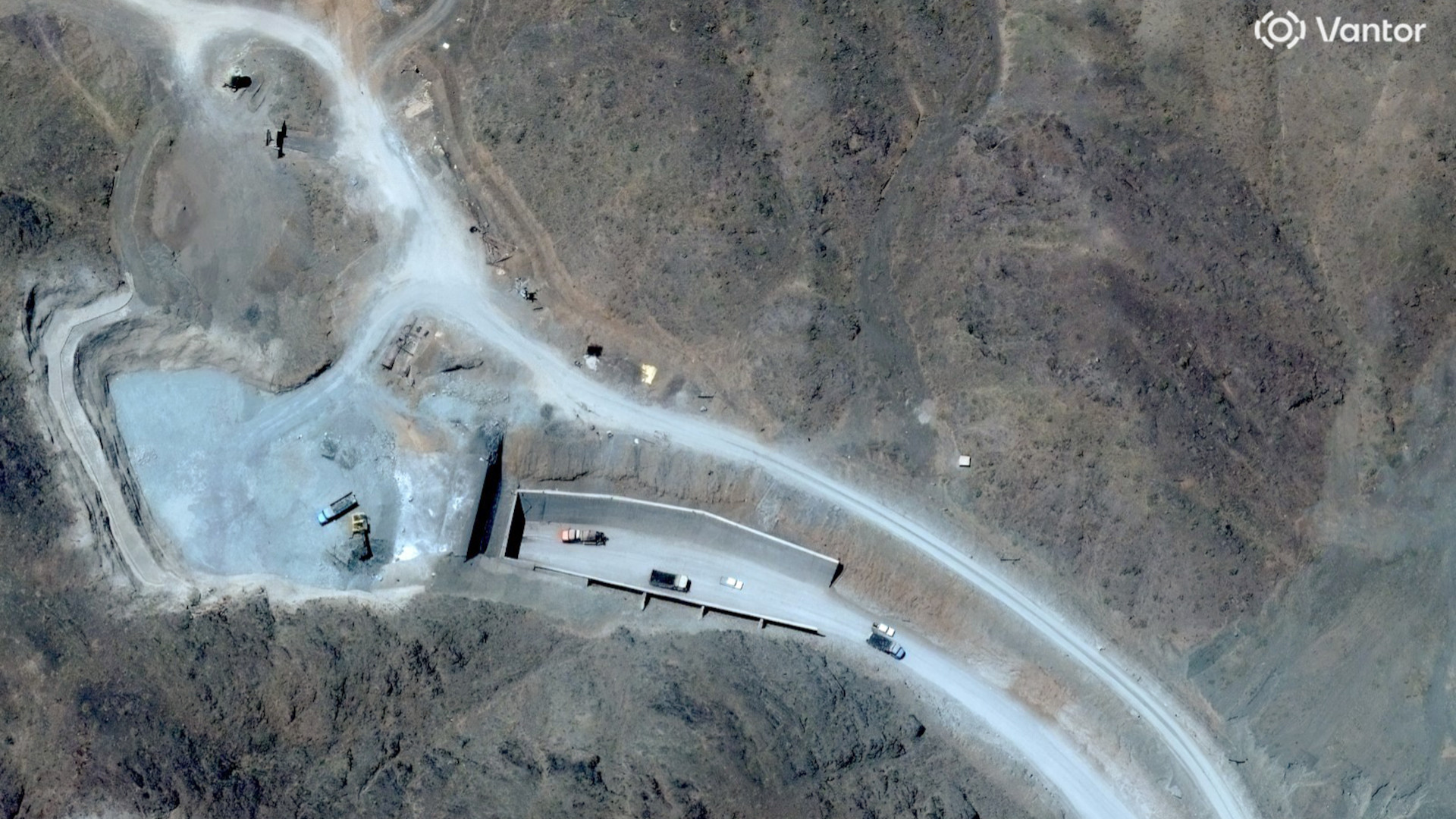
In terms of activity, satellite imagery TWZ has obtained from Vantor, seen below, does show dump trucks and other vehicles moving in and out of one of two entrances to the newer tunnel network on the western side of Pickaxe Mountain on June 21. There are also two other entrances on the eastern side.
Satellite image ©2026 Vantor
Previous satellite imagery had shown Iran taking steps to at least partially block access to the newer facility after the start of U.S. and Israeli strikes on February 28, according to the Institute for Science and International Security (ISIS) think tank. Before the conflict erupted, Iran was also observed to have buried and hardened the entrances to the tunnel network built in 2007, again per ISIS’ assessments.
IRAN NUCLEAR UPDATE: Possible NEW Passive Defensive Measures Noted at Pickaxe Mountain
Based upon newly available satellite imagery of the Pickaxe Mountain underground complex, just south of the Natanz Nuclear Complex, it appears that as early as April 22nd, the two eastern… pic.twitter.com/KGAhBkLks8
— Inst for Science (@TheGoodISIS) May 6, 2026
Last year, TWZ had called attention to efforts to at least partially seal up Iran’s nuclear facility at Fordow before Operation Midnight Hammer. Similar activity has been observed in the past year at Natanz, Isfahan (also written Esfahan), and other hardened nuclear sites in Iran . As we have explored in detail in the past, sealing tunnel entrances and other access points creates an important deterrent to ground raids , as well as potentially offering additional hardening against standoff strikes. We will come back to this later on.
“Unlike the situation at both the Fordow and Esfahan tunnel entrances, this material [at the eastern entrances to the newer facility at Pickaxe Mountain] does not provide complete tunnel entrance obscuration at either portal,” ISIS noted in an assessment back in May . “Nonetheless, this material would appear to be sufficient to significantly hinder rapid ingress/egress by vehicles and would require the use of heavy earth moving equipment to gain such access and clear an unobstructed path inside. At present, we do not yet see evidence of such blockage having been undertaken at the two western tunnel portals of the larger complex.”
A shot in the door and not from above?
All of this brings us back to Trump’s comment about the possibility of a “nice big fat shot right in the front door” at Pickaxe Mountain. For years, experts have talked about the likelihood that the main caverns under the mountain are beyond the reach of even the largest known conventional bunker buster bomb in U.S. inventory, the 30,000-pound-class GBU-57/B Massive Ordnance Penetrator (MOP). The MOP was developed, at least in part, specifically to hold underground facilities in Iran at risk . Construction at Pickaxe Mountain, especially in the past five years, is a clear response to U.S. threats.
MOPs were the centerpiece during the Operation Midnight Hammer strikes, with 12 being dropped on Fordow and another two on Natanz. To get at the actual targets at Fordow, six MOPs were dropped on two specific ventilation shafts , with each successive bomb burrowing deeper down into the complex below. This underscores the challenges that would be involved in attempting a similar operation against Pickaxe Mountain.
A graphic with details about the employment of MOPs on strikes at Fordow during Operation Midnight Hammer. US Military
The available stockpile of MOPs was also understood to be relatively limited even before Operation Midnight Hammer , and it is unknown how many are currently in inventory. The U.S. Air Force is now in the process of acquiring a successor to MOP, called the GBU-76/B Next Generation Peneator (NGP), but that is not expected to enter service for some time.
The United States does also have Earth-penetrating B61-11 gravity bombs in its nuclear stockpile , specifically to prosecute extremely deeply buried strategic targets. However, there is next to no chance the U.S. government would initiate the use of nuclear weapons against Iran absent anything approaching a proportionate, imminent threat or attack. Doing so would be a beyond massive escalation with serious worldwide ramifications, and there is no indication that American authorities are at all considering taking that step.
As with the strikes on Fordow, multiple bombs could be dropped on the same impact point to try to penetrate further down into Pickaxe Mountain. Whether there might be similar ventilation shafts or other weak points that could be exploited at Pickaxe Mountain is unknown. Trump’s remarks to Hugh Hewitt would certainly seem to suggest otherwise.
A strike “right in the front door” on the tunnel entrances at Pickaxe Mountain would be another option to at least hamper access to the facility inside for a time. This could be combined with strikes aimed at sections of the tunnel networks that run deeper inside the facility, but that are still close enough to the surface to be reachable by available conventional munitions. For instance, MOPs may not be able to hit the main cavern areas, but they could possibly hit certain tunnels that might lead to them.
A B-2 bomber drops a GBU-57/B MOP during a test. USAF
Even a combined strike on entrances and shallow tunnels at Pickaxe Mountain could still present certain challenges. Firm intelligence on exactly where the tunnels snake under the mountain could be limited, making it difficult to select the best impact points. This is exactly why the U.S. military has been investing heavily in advanced, void-sensing fuzes for MOP and other bunker buster bombs for decades now. These fuzes detect when a munition has penetrated into a sufficiently large space, such as a room or tunnel in an underground facility, to help maximize damage. Fuzes that can effectively ‘count’ floors also help to ensure the munition has burrowed sufficiently deep before detonating.
It is possible that additional tactics, techniques, and procedures could be brought to bear to increase the effectiveness of any strikes on Pickaxe Mountain and further complicate any efforts to dig out the site afterward. Just last month, TWZ explored in detail the benefits of near-horizontal strikes on fortified targets, as well as of ‘skipping’ munitions into tunnel and cave entrances. The Pentagon’s 2027 Fiscal Year budget proposal had revealed interest in enhancing the capabilities of 2,000-pound-class Joint Direct Attack Munition-Extended Range (JDAM-ER) precision-guided glide bombs in the bunker-busting role, which could further enable these kinds of lateral strikes. If appropriate funding is allocated, the Defense Threat Reduction Agency (DTRA) would be responsible for leading this work. DTRA is a multi-faceted organization focused on responding to Weapons of Mass Destruction (WMD) threats, and notably played a critical role in the development of the MOP.
As noted earlier, the U.S. military could conduct follow-on strikes on the entry points at Pickaxe Mountain to disrupt any attempt to regain access, as well. Trump’s conversation with Hugh Hewitt yesterday indicates that the site is, unsurprisingly, already under heavy surveillance, including by regular spy satellite passes. Currently, this is the tactic being employed at other critical sites, like the similar mountain bunker facility in Isfahan, where it’s thought that much of Iran’s enriched uranium is buried. By striking any equipment or personnel attempting to access the collapsed tunnels, the problem could theoretically be ‘maintenanced’ indefinitely.
Limited access to underground sites for a protracted period of time might have second-order impacts, too. This would depend on whether the equipment or anything else contained therein requires regular maintenance or other attention to remain usable or otherwise prevent degradation.
Other considerations
Mounting a major operation against Pickaxe Mountain of any kind could entail additional complexities and risks. A total of 125 aircraft, including seven B-2 bombers , as well as fighters, tankers, and other supporting platforms, took part in Operation Midnight Hammer. U.S. Navy vessels in the Arabian Sea also conducted Tomahawk cruise missile strikes and otherwise supported the operation. At the same time, Iranian forces, including the country’s air defense capabilities, have been significantly degraded by U.S. and Israeli strikes since then.
A briefing slide depicting just a small portion of the resources involved in Operation Midnight Hammer. US Military
Even so, there is still always the possibility of an aircraft going down due to a technical fault or some other issue. Combat search and rescue (CSAR) assets need to be in position, whether they are used or not. CSAR operations are risky and require immense resources themselves. This was put on full display during the race to rescue the crew of an F-15E Strike Eagle that went down in Iran in April , which resulted in the loss of several additional aircraft and helicopters .
On several occasions in the past , TWZ has highlighted the overall limits of conventional standoff strikes against especially deeply buried facilities, including in Iran . This has been a key driver in discussions about the potential for the United States or Israel to conduct ground raids on Iranian nuclear facilities , either to cause more definitive damage inside or to try to extract key assets, like enriched uranium. Any ground operation would pose its own immense challenges and risks, as we have also explored in detail previously .
“Going after the fissile material, I think, is a bigger operation. Again, I think we have the capabilities to do this. Within our Special Operations community, we have people that are trained to do this and have the right relationships and connections and other things to allow us to get in and do that,” retired U.S. Gen. Joseph Votel, who previously served as head of U.S. Central Command (CENTCOM), told TWZ ‘s Howard Altman when asked about this in an interview in March. “So you’d have to be able to project that force onto the ground. This would be going to a place like Natanz or Isfahan – probably one of those locations. Those are well inland – several hundred miles into Iran, a country of the same size as the state of Alaska. So it’s big and it’s diverse. It’s largely in an open plain, so you don’t have a lot of natural terrain protection there. That would have to be taken into consideration.”
Getting into sites where Iran has deliberately sealed entry points would require heavy machinery and skilled operators, as well as time to do that work. That, in turn, has impacts on the force protection requirements for an operation that could be expected to last days, if not weeks. These forces would be well within the reach of Iranian artillery, drones and other weapons, as well as ground forces and direct fires. It is also interesting to consider here that if at least some of the entrances to the facilities underneath Pickaxe Mountain are not currently completely sealed off, the raid package could be lighter and the operation faster. In September 2024, Israeli ground forces were notably able to destroy an underground missile factory in Syria after gathering significant amounts of intelligence in an overnight operation . That being said, one would expect a site as sensitive as Pickaxe Mountain to be better defended on the ground, even if the ‘doors are open.’
There is a question here of the relative value of strikes on Pickaxe Mountain, especially depending on what U.S. planners think they could reasonably achieve. As noted earlier, exactly what is under the mountain at this point is not clear.
“It remains unclear when it could be operational, based on assessing satellite imagery,” David Albright, President and Founder of the ISIS think tank, wrote in a post on X just yesterday. “Recently, we were told that the site was not attacked in the two previous wars [the 12-Day War in 2025 and operations this year] because nothing of sufficient value was inside it.”
Pickaxe Mtn to be attacked?
We have often written about Pickaxe mountain on our website over the last five years. A recurring question over the last year has been why was it not attacked. Trump’s announcement a few hours ago means an attack could happen soon.
Pickaxe Mtn is a… pic.twitter.com/V7mUDcp5Cr
— David Albright (@DAVIDHALBRIGHT1) July 14, 2026
“Perhaps that assessment has changed,” Albright continued. “But just as likely, Trump does not want to leave Iran with a deeply buried nuclear-related site as the regime appears to be sending signals it is starting to rebuild its nuclear weapons capabilities aimed at making nuclear weapons.”
President Trump’s response yesterday to Hugh Hewitt’s specific mention of Pickaxe Mountain does point to there being some degree of concern about this target within the current administration. Trump being so familiar with the site and its weaponeering challenges is particularly notable.
Still, how soon a U.S. strike on Pickaxe Mountain might actually come, if at all, and what that might entail, remains to be seen. Though destroying the facility would be an extremely tall order, there are still other options to make it hard for Iran to make use of it, at least in the near term.
Contact the author: joe@twz.com
The post Trump’s Threat To Strike Iran’s Pickaxe Mountain Bunker’s “Front Door” Underscores Targeting Challenges appeared first on TWZ .

















Comments
No comments yet — be the first to weigh in 👇
No comments yet. Be the first!