Full text
It’s a story we just can’t seem to quit. From antiquity to outer space, literature and film are filled with scrappy adventurers struggling to get home.
This week, Christopher Nolan cashes in on that safe narrative bet with a new Odyssey starring Matt Damon and Anne Hathaway. We may debate the success of this latest epic. But one thing’s for sure: Homer’s story isn’t going anywhere.
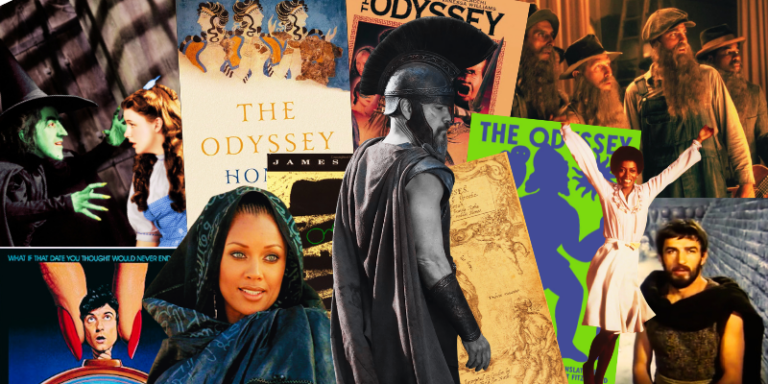
Speaking of stories—of the dozens and dozens of adaptations, it’s also true that some Nobodies are better than others. Here’s an irrefutable, completely objective and scientific list ranking odysseys for ye discerning adventurers.
10.
Michael Caine’s AI-dyssey (2026)
The actor Michael Caine recently licensed his plummy voice to a large language model, so now a robot avatar can read you the tale. This sucks for several reasons . But today my favorite is: AI narrators defeat the point of storytelling.
If the person ostensibly reading the epic aloud to you was too lazy to actually read the epic, what are we even doing here, friends? Last place, with a bullseye.
9.
L’Odissea (1968)
In a recent New Yorker letter, the critic David Denby explored why The Odyssey has bested so many adaptors . As case in point, he revisits an eight-part Italian miniseries in which Ithaca is rendered fairly dull.
Denby dismissed the series—which you can currently watch in French on Youtube —as highbrow 60s kitsch. “As the camera roams the ruins of Troy, we get a stern historical lecture, followed by heavily populated scenes of actors standing around talking or gazing out to sea. The moviemaking is faithful, literal, and dead.” Ouch.
8.
The Odyssey (1997)
Did you know there was a glossy Odyssey mini-series released in 1997? (And that it starred Eric Robert s and Vanessa Williams ?!)
This epic didn’t seem to stick in the culture’s craw—even though per Variety , on it release, it was “on a minute-to-minute basis the most expensive TV drama ever made.” This tale was critically dinged for the same problem Denby identified above. Though its adventure scenes were praised, the script lacked the “ insight or depth ” of the source material.
7.
Ulysses (1954)
This first major Hollywood spin on the story was also epic in scale, but knocked in The New York Times for a technicolor tawdriness and casting.
And alas, poor Kurt! Critic Bosley Crowther yearned for “someone a trifle more transcendent” in the lead role.
6.
George Chapman, The Odyssey (1616)
Though non-scholars may find the 1616 version a little roomy in the elbows, Chapman’s Odyssey brought the epic to English-reading shores. And hey, firsts are important.
His project wasn’t wholly faithful to the Greek, though. Writing in the Los Angeles Review of Books , historian Richard H. Armstrong noted that Chapman’s translation is “surrounded by punchy commentary and wild claims, both for Homer’s genius and his own bona fides as a translator.” Ego follows ego, I suppose.
5.
James Joyce, Ulysses (1922)
I know, I know. It’s hard to make space for deviant adaptations. By this metric, we might also include Charles Frazier’s Cold Mountain , or Scorsese’s After Hours, or [insert most any adventure/return story here]. I take your quibbles on the chin.
But I’d be remiss to ignore Ulysses’ most direct literary descendant. Here, Dublin is Ithaca, and the timeline is compacte. But something tells me Homer would approve.
4.
L. Frank Baum & Victor Fleming, The Wizard of Oz (1939)
While we’re in the neighborhood of slant adaptations, here’s my case for Oz. In this odyssey, we find a key spin on the hero’s journey. Dorothy Gale is not here to be humbled; nor does she arrive on the scene as confident as her antecedent. Her odyssey is about stepping into power, not abdicating it. Which makes this voyage home all the more poignant.
(See also: The Wiz .)
3.
Emily Wilson, The Odyssey
Called “ brisk and understated ” on its 2018 release, Wilson’s Odyssey put the epic back on the map for a wide modern audience. According to critics like Annalisa Quinn at NPR , the classicist winnowed down the “nostalgic detritus” that makes older versions of the story feel stodgy.
Wilson also rendered the yarn in “friendly iambic pentameter,” which some readers felt recaptured a conversational rhythm suitable to a story designed to be read aloud.
2.
Robert Fitzgerald, The Odyssey (1961)
Scholars can debate translation merits just as long as film nerds. Do we dig the academic Lattimore, or the cinematic Fagles? This new Mendelsohn looks exciting. But what about Cesar Pavese?
Speaking from the public school of which-book-got-you-personally-hyped, I’m a Fitzgerald fan meself. Writing in a 1974 New York Review of Books , the critic D.S. Carne-Ross praised this beloved translation of The Odyssey for its unparalleled poetry: “No previous rendering was entirely satisfactory.”
1.
Coen Brothers, O Brother Where Art Thou (2000)
When asked to think about singularly American art works last week, this romp through a Depression-era Mississippi sprang outta my head like Athena. In the Coen brothers’ film, we have foibles, jailbreaks, sirens out of Appalachia, and a South that can be as dapper as it is violent.
As Denby reminds us, “Odysseus is a warrior with wit and intellect, a con man and fabulist who constantly reinvents himself.” Clooney’s Ulysses (…Everett McGill) reps the second part of that description, highlighting the war hero’s under-praised flair. It takes an inventive man, after all, to whip up a chart-topping ear-worm at a moment’s notice.
Whichever your muse, Nolan or Joyce, may you not wander too long.












Comments
No comments yet — be the first to weigh in 👇
No comments yet. Be the first!