Ukraine deploys world's first armed ground robot ashore via sea drone behind Russian lines
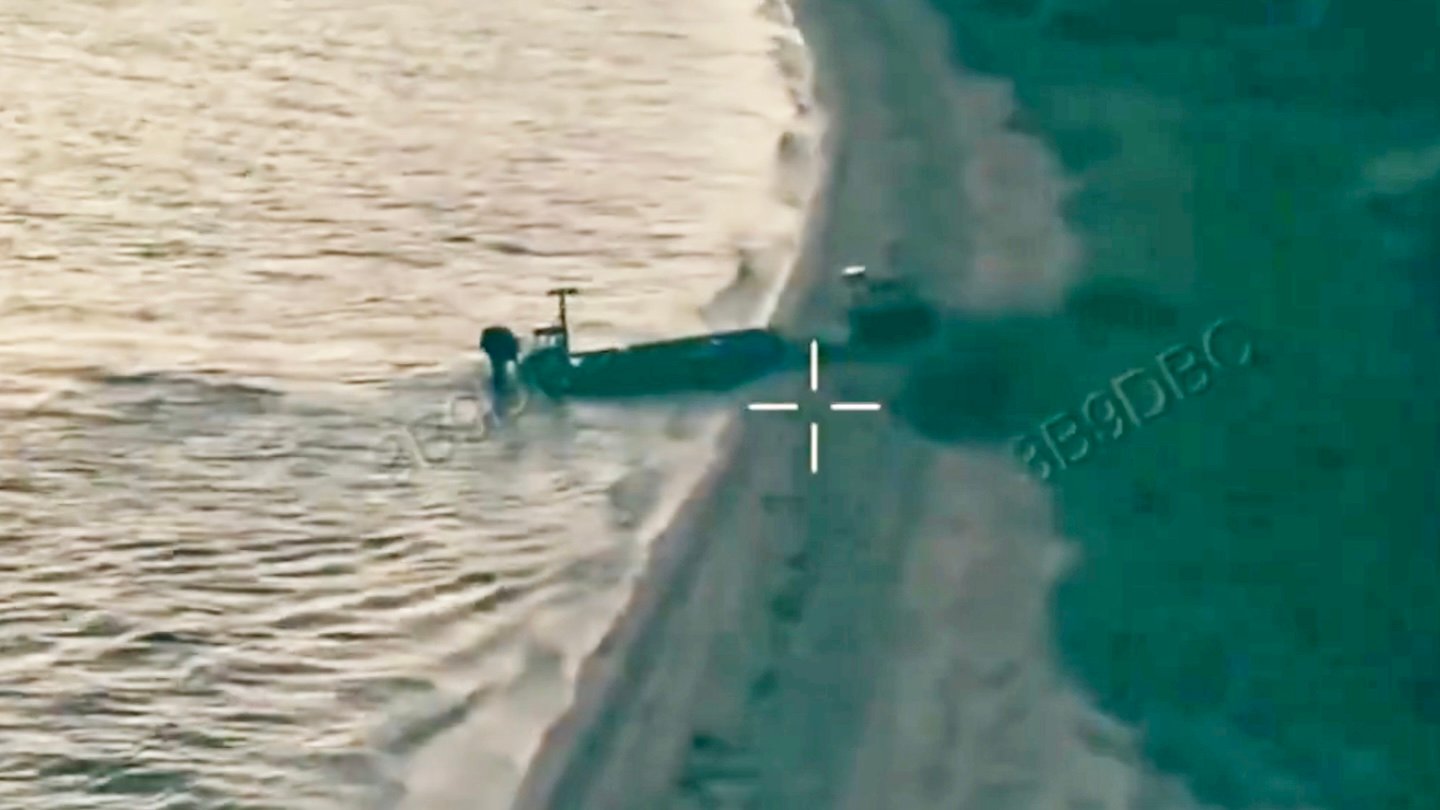
Ukraine's 123rd Separate Territorial Defense Brigade carried out the world's first known combat mission in which a sea drone transported and deployed an armed ground robot behind Russian lines on the Russian-occupied Kinburn Spit in the Mykolaiv region. The robot rolled inland to engage the enemy without a single soldier landing on the shore. The operation highlights Ukraine's rapid adoption of uncrewed systems to counter Russia's invasion.
Full text
A robotic boat glides through the darkness, reaches an occupied shoreline, and releases an armed ground robot that rolls inland to fight without a single soldier setting foot on the beach. While this sounds like a scene from a future war, it recently played out in southern Ukraine, reflecting Kyiv’s rapid embrace of uncrewed systems as it seeks to counter Russia’s invasion.
No soldiers. Just machines.
Ukraine has carried out the world's first known combat mission in which a sea drone transported and deployed an armed ground robot behind Russian lines on the occupied Kinburn Spit. pic.twitter.com/zyJdFXWxVb
— Ivan Khomenko (@KhomenkoIv60065) July 13, 2026
Described as the first of its kind anywhere in the world, the operation took place on the Russian-occupied Kinburn Spit in Ukraine’s southern Mykolaiv region, according to Ukraine’s 123rd Separate Territorial Defense Brigade, which carried it out on an unspecified recent date.
A map showing the approximate location of Kinburn Spit in Ukraine’s southern Mykolaiv region. Google Earth
“A new era of war begins with the decisions of courageous commanders,” the brigade stated today on its Telegram page, adding that the operation was led by the 123rd’s commander, Col. Oleg Makukha. The mission involved the brigade’s 1st Unmanned Systems Battalion, under Maj. Denys Gipik.
The UGV goes onto the spit as seen from the USV. 123rd Separate Territorial Defense Brigade screencap
A video published by the brigade shows parts of the operation from an overhead aerial drone as well as from the uncrewed ground vehicle (UGV), and from the vessel that transported it to the shore. The uncrewed surface vessel (USV), powered by an outboard motor, beaches itself before lowering a bow ramp that allows the wheeled UGV to drive ashore. Armed with a machine gun, the UGV is then seen engaging a target beyond the beach. The USV subsequently departs, although it is unclear whether any attempt was made to recover the UGV.
A wider view of the beach as the USV heads toward the shore. 123rd Separate Territorial Defense Brigade screencap
The UGV appears to be a member of the Rys family, produced by Roboneers and armed with a 7.62mm machine gun. These platforms typically incorporate a ballistic computer for accurate fire and artificial intelligence that assists with autonomous target detection, tracking, and engagement.
The UGV’s view of the machine gun mount. 123rd Separate Territorial Defense Brigade screencap
The Rys family of vehicles is already widely used for logistics, casualty evacuation, combat engineering, and combat support missions. Variants have also been configured for minelaying and demining operations.
A Ukrainian UGV being used for the evacuation of wounded soldiers:
A Ukrainian robotic evacuation vehicle equipped with an armored capsule successfully rescued a wounded soldier from a frontline position.
During the extraction, the vehicle struck two mines on its return route. Despite the blasts, the armored capsule protected the wounded… https://t.co/84Cv2IMueX pic.twitter.com/rjwdARtyJ6
— Special Kherson Cat (@bayraktar_1love) May 22, 2026
Ukraine has stepped up its use of similar UGVs, which it claims have been crucial in certain engagements. Earlier this year , a Droid TW-7.62, also fitted with a 7.62mm machine gun, is said to have destroyed two Russian drones before opening fire on Russian infantry, killing one and injuring another. The Droid remained in the fight, despite artillery fire, and pushed back another Russian infantry attack.
Interesting use of Ukrainian UGV Droid TW-7.62 equipped with an FN MAG machine gun to shoot down FPV drones over Kramatorsk, Ukraine.
The robot warfare is here. pic.twitter.com/7Y2zj2jdoP
— Dimko Zhluktenko (@dim0kq) March 15, 2026
You can read our in-depth account from inside Ukraine’s effort to build its UGV arsenal here .
Meanwhile, the Kinburn Spit is among southern Ukraine’s most fiercely contested coastal areas.
Russian forces occupied the roughly six-mile-long, narrow spit in the summer of 2022. Overlooking the mouth of the Dnipro River, it became a base for electronic warfare systems as well as missile and artillery strikes against southern Ukraine. Russia also constructed concrete bunkers and reportedly established a drone control station there.
A close-up view of Kinburn Spit. Google Earth
Ukraine has repeatedly targeted the spit since late 2022 with reconnaissance missions, raids, and precision strikes in an effort to erode Russia’s hold on the area. Although Moscow retained control for much of the war, Ukrainian attacks steadily increased the cost of defending the position.
As of June, the Institute for the Study of War, a U.S. think tank, reported that Russian troops had withdrawn from the spit under sustained Ukrainian pressure, while Ukrainian marines later flew a national flag there using a drone. Russian forces retreated under heavy fire, with the evacuation of surviving personnel continuing, a statement from Ukraine’s Southern Defense Forces said on June 25.
Whether Russian forces have since returned in some capacity remains unclear, meaning the latest operation may have been intended as reconnaissance, a technology demonstration, or both.
Regardless of the current disposition of Russian troops, the Kinburn Spit is an ideal proving ground for uncrewed operations. Heavy surveillance, artillery, and drone coverage make conventional amphibious landings exceptionally dangerous, while robotic systems can conduct reconnaissance and combat missions without exposing troops to direct fire.
I held a Staff meeting. Three key issues.
First – UGVs. It is unmanned ground vehicles that are currently one of the most urgent needs of our Defense Forces, and production and supply must keep pace with demand. The volume of contracting for UGVs must be significantly higher…
— Volodymyr Zelenskyy / Володимир Зеленський (@ZelenskyyUa) April 27, 2026
The operation reflects Ukraine’s growing reliance on uncrewed systems, with ground robots increasingly taking on high-risk tasks such as logistics, engineering, fire support, and battlefield scouting to reduce the exposure of frontline troops. At the same time, Ukraine has become the world’s leading innovator in uncrewed surface vessels, fielding versatile platforms for strike missions , intelligence gathering, logistics, and, increasingly, the deployment of other robotic systems .
While the mission was likely something of a battlefield proof-of-concept, it provides more evidence of Ukraine’s rapid pace of innovation in the field of uncrewed systems. It could also provide a glimpse of a future where amphibious landings are led by uncrewed systems.
Reflecting on the Kinburn Spit operation, the 123rd Brigade offered a simple prediction: “It’s going to get even more interesting.”
Contact the author: thomas@thewarzone.com
The post Ukraine Lands Armed Robot Ashore In Russian-Held Territory Via Drone Boat appeared first on TWZ .
Should autonomous combat robots replace soldiers in such operations?
Comments
No comments yet















Comments
No comments yet — be the first to weigh in 👇
No comments yet. Be the first!