Full text
A supermassive black hole at the heart of a nearby galaxy is behaving similarly to black holes that existed just after the Big Bang, voraciously feeding on copious amounts of matter. The relatively close cosmic titan could therefore provide insight into the much more distant universe.
Indeed, the intense accretion behavior demonstrated by the supermassive black hole , which sits at the center of the galaxy SDSS J110546.07+145202.4 located 1.8 billion light-years away, is something scientists have only ever seen in the earliest supermassive black holes.
SDSS J110546.07+145202.4 has been shining brightly in radio waves for many years, and these waves were the smoking gun that pointed to the feeding habits of the galaxy's central black hole.
"Such high-energy events can provide astronomers with a wealth of insights," Kovi Rose from the University of Sydney’s Sydney Institute for Astronomy said in the statement . "By observing these jets and outbursts, we can study the physical processes in some of the most extreme environments in the universe."
Even the hungriest black holes are messy eaters
All large galaxies have a supermassive black hole at their heart with masses of millions or even billions of times that of the sun . However, not all supermassive black holes accrete vast amounts of matter.
For example, the supermassive black hole at the heart of our galaxy , the Milky Way, Sagittarius A* , consumes so little gas and dust from its surroundings that, were it a human being, it would be existing on a diet of one grain of rice every million years. (That is one heck of a diet.)
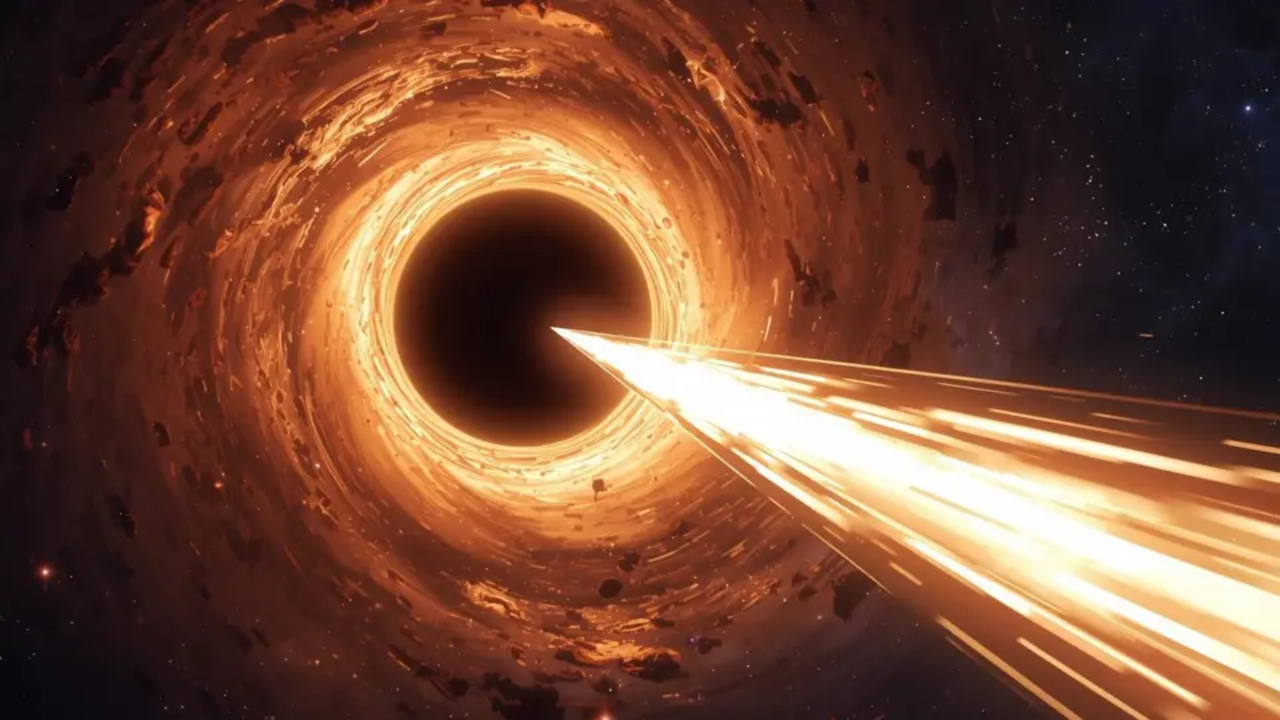
When black holes are surrounded by copious amounts of gas and dust, their immense gravitational influence causes this material, in a flattened swirling cloud called an accretion disk, to glow brightly across the electromagnetic spectrum, from low-energy radio waves to high-energy X-rays.
Additionally, supermassive black holes are notoriously messy eaters, meaning some of the matter in accretion disks is channeled to the poles of the black hole, from where it is blasted out as jets of plasma traveling at speeds approaching the speed of light. These jets too are responsible for bright emissions of electromagnetic radiation.
Radio signals from the spiral galaxy SDSS J110546.07+145202.4 underwent a 20-fold increase in radio brightness over a short period, increasing to around 10 quadrillion times the intensity of the radio brightness of the sun. This happened around 8 years ago, and the galaxy has yet to show any sign of dimming.
"We are dealing with the prototype of a new class of galaxies that undergo rapid changes in radio emission," team member Phil Edwards from CSIRO, Australia’s national science agency, said.
Team leader Stefanie Komossa of the Max-Planck-Institute for Extraterrestrial Physics in Garching, Germany, added: "Luminous radio radiation from rapidly growing, lightweight black holes is rare to begin with. Their transition into a long-lasting, radio-bright state has never been observed before."
The galaxy SDSS J110546.07+145202.4 is so close to Earth that its shape, with its two spiral arms, can be clearly seen in images. (Image credit: DESI Legacy Survey) The source of this electromagnetic radiation is situated at the heart of SDSS J110546.07+145202.4, right by its central supermassive black hole. The team thinks the brightening of this galaxy began because the rate of matter falling into its supermassive black hole had increased, triggering the generation of plasma jets.
The increase in mass consumption of the supermassive black hole is leading to a level of growth that hasn't been seen in black holes outside of the early universe before. That means that SDSS J110546.07+145202.4 and its feasting supermassive black hole are set to be prime targets for astronomical investigations for some time to come, especially as proxies for ravenous black holes and rapidly growing early galaxies.
"With sensitive facilities like the incoming SKA telescopes, we'll be able to identify similar radio transients in future sky surveys," Komossa said. "This is crucial for filling the gaps in our understanding of the early universe."
The team's research was published in May in The Astrophysical Journal.

















Comments
No comments yet — be the first to weigh in 👇
No comments yet. Be the first!