Trump threatens to cut trade with Spain – what would the US military lose?
At the NATO Summit in Ankara, President Donald Trump called Spain a "wasted cause" and "terrible partner," threatening to cut off all trade relations with the country. Spain hosts two major US military installations: Naval Station Rota and Morón Air Base, both critical to American operations in the Atlantic and Mediterranean. Losing access to those bases would significantly weaken Washington's military reach in Europe and Africa.
Full text
In his latest spat with a fellow NATO member, U.S. President Donald Trump condemned Spain as a “wasted cause” and “terrible partner” in the alliance. Speaking at the NATO Summit in Ankara, as NATO Secretary General Mark Rutte looked on, Trump said he wanted to cut off all trade relations with Spain. While Spanish officials have stressed that relations won’t be affected, it does raise questions about the long-term status of the U.S. military presence in Spain, should the situation deteriorate further.
. @POTUS : "Spain is a wasted cause. We don't want to do any trade business with Spain anymore by the way… Spain is a terrible partner in NATO. They don't participate, they don't pay. I don't want anything to do with Spain." pic.twitter.com/3prqux6p54
— Rapid Response 47 (@RapidResponse47) July 8, 2026
“We don’t want to do any trade business with Spain anymore… I’d like you to cut it off,” Trump said. “Spain is a terrible partner in NATO. They don’t participate; they don’t pay. I don’t want anything to do with Spain. Cut off all trade with Spain, please, including visits. Watch them, watch them come running back; oh, they’ll come running back.”
He continued: “We don’t have to trade with them. I don’t want to do any more trade with them… Don’t even talk to them; they’re hopeless, bad people, because you know they have everybody else going and paying and working… They’re open about it, they’re hostile about it, and let’s see how hostile they remain when they call up, and they ‘please, please, we want to trade with you, sir. We want to trade with you, sir.’ They make so much money with us, and we’re going to see that they make a lot less. I want no business with them.”
According to U.S. Congress figures, mutual trade between the two countries was worth $75 billion in 2025, and the United States made $3 billion more from the relationship than Spain.
In an effort to heal the rift, Spanish Prime Minister Pedro Sánchez later insisted that relations with the United States were “very positive,” and that he had spoken to Trump.
“We talked about the World Cup… there was no tension whatsoever, on the contrary it was all very friendly,” said Sánchez.
Spanish Prime Minister Pedro Sanchez downplays tensions with President Donald Trump after the US leader threatens to halt trade with the NATO ally, describing their exchange as informal and courteous with “absolutely no tension.” pic.twitter.com/SRNfdfuWkV
— Al Arabiya English (@AlArabiya_Eng) July 8, 2026
The BBC reported that government sources in Madrid said that Spain had no plan to change their “excellent social, cultural, and economic relationship.”
The background to this is Trump’s unhappiness with the Sánchez government refusing the U.S. military permission to use its bases at Morón and Rota in Spain for missions during the war against Iran.
Another point of conflict is Sánchez’s refusal to increase defense spending to five percent of GDP, in line with NATO targets.
This is not Trump’s first threat to cut off trade relations with Spain. The same had happened back in March , in response to Sánchez’s stance on the Iran war.
While there was no change to trade between the two countries after that, were relations between the United States and Spain to worsen, the continued access to Morón and Rota would become a question.
The approximate location of Morón and Rota in southern Spain. Google Earth
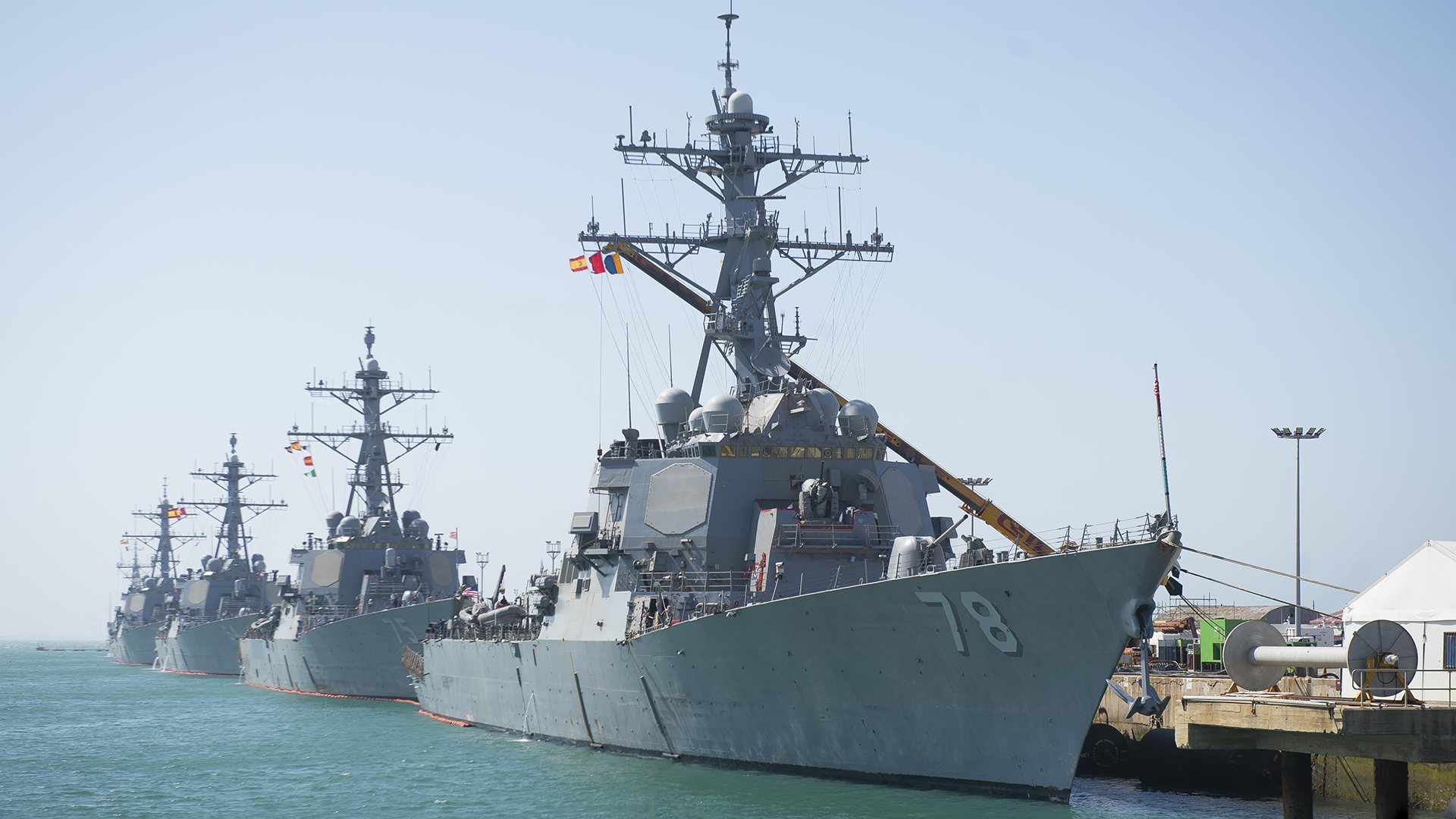
Of the two, Naval Station Rota, in the province of Cádiz, is the most critical. It sits in a strategic position at the mouth of the Mediterranean, which is one of the world’s most important naval control points.
Described by the U.S. Navy as “the gateway to the Mediterranean,” Rota is one of the most strategically important U.S. military hubs in Europe, critical to supporting U.S. and allied naval operations across multiple theaters. The installation is central for Naval Forces Europe-Africa/Central (EURAFCENT) and the U.S. Sixth Fleet.
Located on a 6,100-acre Spanish Navy facility in southern Spain, Rota functions as a major logistical gateway linking North America with Europe, the Mediterranean, Africa, and the Middle East.
Naval Station Rota. Google Earth
The base supports the movement of personnel, equipment, fuel, and supplies through its three operational piers, a 670-acre airfield capable of supporting U.S. Navy and Air Force aviation operations, and some of the largest weapons and fuel storage facilities in Europe.
Perhaps the highest-profile resident unit at Rota is Destroyer Squadron 60 (DESRON 60), one of three U.S. Navy destroyer squadrons permanently based outside the continental United States and the only one of these to call Europe home.
In 2024, the Arleigh Burke class destroyer USS Oscar Austin arrived at Rota, as the first of two additional destroyers to join the Forward Deployed Naval Force-Europe, which will have an eventual total of six. These warships are notably modified with special defenses tailored to the European theater, as you can read about here .
The USS Oscar Austin arrives at its new homeport of Naval Station Rota, Oct. 15, 2024, as the first of two additional DDGs to join the Forward Deployed Naval Force-Europe. U.S. Navy
A SeaRAM defense system awaits testing aboard USS Porter , March 3, 2016. Porter , a destroyer forward-deployed to Rota, Spain, was preparing for deployment in the U.S. Sixth Fleet area of operations. U.S. Navy photo by Lt.j.g Laura Adams/Released U.S. Naval Forces Europe-Africa/
Other key Navy units at Rota include Helicopter Maritime Strike Squadron Seven Nine (HSM-79), the “Griffins,” flying the sub-hunting MH-60R Seahawk , and Explosive Ordnance Disposal Mobile Unit Eight.
MH-60R Seahawk helicopters assigned to Helicopter Maritime Strike Squadron 79 land on the flight deck of the Spanish Galicia class landing platform dock Castilla during a bilateral flight operations exercise at Rota, April 28, 2026. U.S. Navy photo by Mass Communication Specialist 1st Class Drace Wilson Petty Officer 1st Class Drace Wilson
Turning to Morón, this airbase is located southeast of the city of Seville in southern Spain. While Naval Station Rota is a springboard for U.S. maritime forces, Morón provides a similar role for the Air Force. Its strategic position means it plays a key role as a forward operating location for air operations, rapid response missions, and contingency support across Europe, Africa, and the Middle East.
Morón Air Base. Google Earth
The base’s capabilities include airfield operations, aircraft support, logistics, maintenance, communications, security, and host-nation support, all of which are geared toward rapid deployment and sustainment of U.S. forces when and where they are needed.
U.S. Marines with Special Purpose Marine Air-Ground Task Force-Crisis Response-Africa (SPMAGTF-CR-AF) 19.1, Marine Forces Europe and Africa, prepare to conduct a helicopter support team training event using a U.S. Marine Corps MV-22 Osprey at Morón Air Base, Spain, March 13, 2019. U.S. Marine Corps photo by Sgt. Katelyn Hunter Staff Sgt. Katelyn Hunter
Resident U.S. Air Force units at Morón, under the Third Air Force, include the 496th Air Base Squadron, a geographically separated unit (GSU) that comes under the command of the 86th Airlift Wing at Ramstein Air Base in Germany. The 86th Airlift Wing flies C-130J airlifters as well as C-21A and C-37A staff transports.
Morón also serves as a critical node in the transatlantic and transeuropean tanker bridges, making it a key logistical gateway for the massive movements that are critical to buildups in Europe and the Middle East, as well as for more routine transatlantic deployments.
A KC-10, KC-46, and three KC-135s sit on the flight line at Morón Air Base on April 14, 2022. At the time, the three airframes represented the entire might of the U.S. Air Force’s refueling arsenal. The KC-10 has since been retired. U.S. Air Force photo by Staff Sgt. Nathan Eckert Tech. Sgt. Nathan Eckert
As well as other U.S. Air Force assets that temporarily deploy to Morón, including from the Bomber Task Force, the base also regularly hosts deployments of U.S. Marine Corps aircraft.
Two B-1B Lancers with the 9th Expeditionary Bomb Squadron from Dyess Air Force Base, Texas, are prepared for takeoff in support of Bomber Task Force Europe at Morón Air Base, Spain, April 4, 2024. U.S. Air Force photo by Senior Airman Zachary Wright Staff Sgt. Zachary Wright
Both Morón and Rota operate under the U.S.-Spain Agreement on Defense Cooperation, which allows the United States and Spain to operate alongside one another and share critical infrastructure.
Morón Air Base and Naval Station Rota remain key nodes in the U.S. military’s global posture, providing a strategically positioned bridge between Europe, Africa, and the Middle East. Their combined capabilities allow U.S. forces to rapidly move, stage, and sustain aircraft, ships, personnel, and equipment across multiple theaters.
A Spanish Air Force Eurofighter flies next to a U.S. Marine Corps MV-22 Osprey with Special Purpose Marine Air-Ground Task Force-Crisis Response-Africa 20.1, Marine Forces Europe and Africa, as part of a tactical recovery of aircraft and personnel (TRAP) exercise near Morón Air Base, Spain, May 6, 2020. U.S. Marine Corps photo by Cpl. Kenny Gomez Sgt. Kenny Gomez
A loss of access to Morón and Rota would extend far beyond a bilateral dispute between Washington and Madrid. While the United States could maintain operations through other European and regional locations, replacing the unique combination of air, maritime, and logistical capabilities provided by the two installations would take time and impose additional strain on U.S. forces. Loss of access to these bases, especially Rota, could be one of Spain’s most powerful cards to play if Trump’s rhetoric turns into action.
More importantly, any decision by a NATO member to restrict access to critical allied infrastructure would have broader implications for the alliance, raising questions about the reliability of defense commitments and the political cohesion that underpins collective security.
Contact the author: thomas@thewarzone.com
The post What The U.S. Military Could Lose If Trump Cuts Off Trade With NATO Ally Spain appeared first on TWZ .
Should Trump follow through on cutting trade relations with Spain?
Comments
No comments yet














Comments
No comments yet — be the first to weigh in 👇
No comments yet. Be the first!