Full text
Around 100,000 years ago, an early Homo sapiens man was probably stabbed in the face with a sharp stone tool and later buried in a cave in what is now Israel, archaeologists have determined. The Stone Age cold case appears to be the earliest evidence of this kind of interpersonal violence, according to the research team.
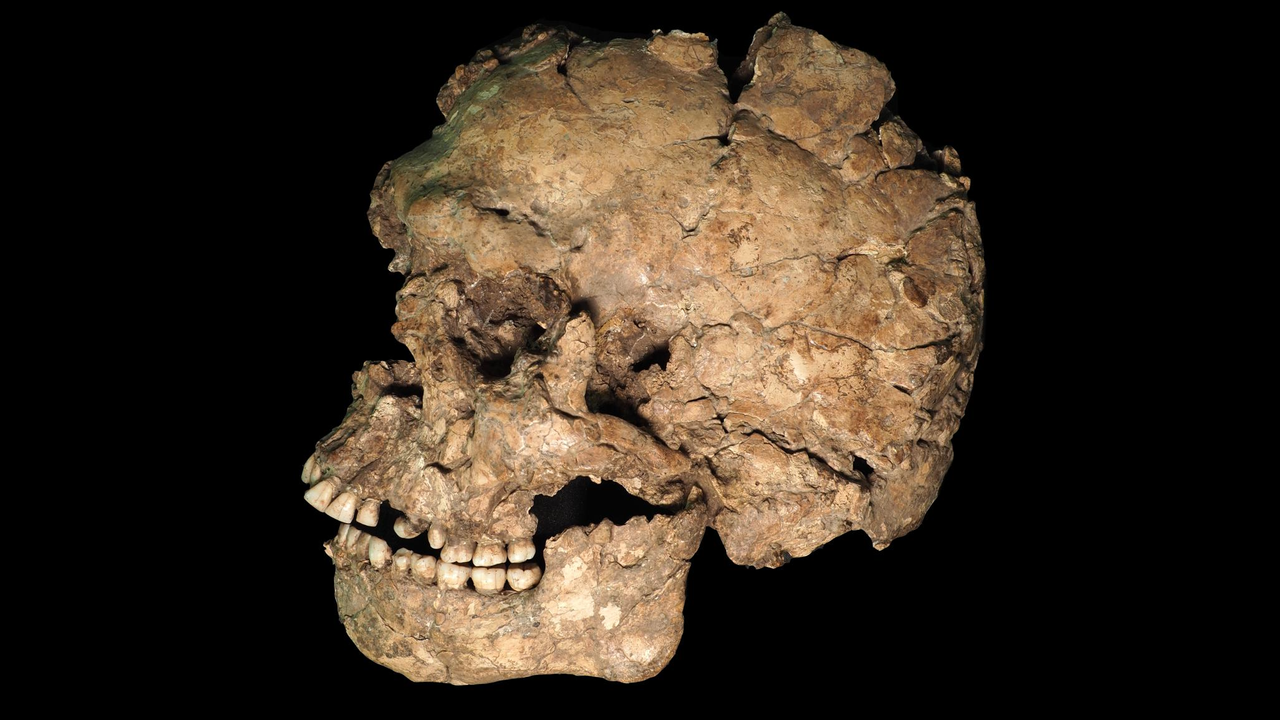
In a study published June 30 in the journal Scientific Reports , the international team of researchers closely examined the skull and lower jaw of a person who was deliberately buried in Qafzeh cave in Israel during the Middle Paleolithic period.
At least 27 people were buried in Qafzeh cave between about 145,000 and 92,000 years ago, making them some of the earliest members of our species to be found outside Africa. Previous analysis of the skeletons, which were excavated between the 1930s and 1970s, revealed that two people had head injuries resulting from blunt trauma.
But the new analysis, which employed microscopic and micro-CT scanning techniques, revealed that Qafzeh 25, an adult male, had a cut mark across his lower left jaw that affected one of his bicuspids and part of his upper jaw. The jawbone showed signs of healing, suggesting that the man lived for a significant amount of time after being injured, the researchers wrote in the study.
Archaeologists had previously identified only a few cases of trauma caused by sharp weapons or projectiles in Middle Paleolithic skeletons. Although these injuries could have resulted from hunting accidents, the researchers wrote, they have generally been interpreted as evidence of interpersonal violence.
The cut mark on the jaw of Qafzeh 25 was found on the left side of his face, lending further support to the idea that the injury was not an accident.
A close-up of the left side of the lower jaw, showing a cut mark near a bicuspid. (Image credit: Ana Pantoja et al.) It's not clear what kind of tool made the cut mark, but stone tools found at Qafzeh included flint scrapers and sharp points that could have been fashioned into spear tips.
"Forensic studies of modern human populations have reported that craniofacial injuries resulting from blows are more frequently observed on the left side of the skull, a distribution commonly attributed to the predominance of right-handed assailants in face-to-face confrontations," the researchers wrote.
RELATED STORIES
Neanderthals and modern humans may have shared culture 59,000 years ago in Turkey, study finds
Early Homo sapiens may have lived in rainforests, new clues suggest — and it could overturn our understanding of human evolution
Homo erectus genetic material sequenced for the first time, and it shows 'deep genetic links' with modern humans
If the researchers' interpretation of the cut mark is correct, it "would represent the earliest documented case of sharp force trauma in the archaeological record," they wrote.
Qafzeh cave is already well known within archaeology for its clear evidence that early humans buried their dead. The new discovery confirms that the earliest human groups left Africa with a complex culture.
"These results provide new data to the debate on the origin of complex behaviors such as interpersonal violence, the care of injured or sick individuals and funeral practices," study first author Ana Pantoja Pérez , a paleoanthropologist at Spain's National Research Center for Human Evolution, said in a statement .
See how much you know about early humans with our human evolution quiz!
















Comments
No comments yet — be the first to weigh in 👇
No comments yet. Be the first!