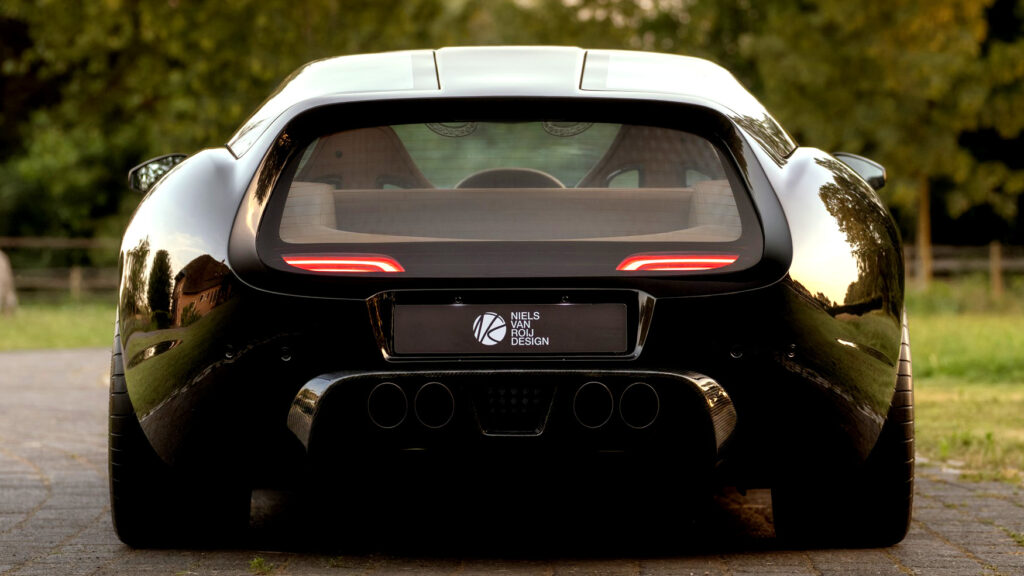
One-off Ferrari Daytona Shooting Brake Homage took over 15,000 hours to build
Dutch design studio Niels van Roij Design has unveiled a one-off Ferrari Daytona Shooting Brake Homage, a modern tribute to the legendary 1972 original. Nearly every exterior body panel was redesigned and hand-built from aluminium, and the Ferrari-based V12 grand tourer required over 15,000 hours to complete. Uniquely, the car loads luggage through butterfly windows rather than a conventional tailgate.
Full text
One-off reimagines the 1972 Daytona Shooting Brake for the modern era.
Nearly every exterior body panel was redesigned and hand-built from aluminum.
The Ferrari-based V12 grand tourer required over 15,000 hours to complete.
Plenty of high-end cars exist to chase lap times or to go where few others could. This one, though, exists as an homage to a legendary Ferrari . The Daytona Shooting Brake Homage from Niels van Roij Design might actually improve on the original. Granted, it probably should, considering that it took more than 15,000 hours to create.
var adpushup = window.adpushup = window.adpushup || {que:[]};
adpushup.que.push(function() {
if (adpushup.config.platform !== "DESKTOP"){
adpushup.triggerAd("0f7e3106-c4d6-4db4-8135-c508879a76f8");
} else {
adpushup.triggerAd("82503191-e1d1-435a-874f-9c78a2a54a2f");
}
});
Read: Ferrari Daytona Shooting Brake Is A One-Off Oddity
The project draws on the unique 1972 Daytona Shooting Brake that Luigi Chinetti Jr. commissioned based on the era’s Ferrari 365/4 Daytona. That original coachbuilt car came from Panther Westwinds and was itself inspired by Giotto Bizzarrini’s Ferrari 250 GT SWB “Breadvan.”
Redesigned From Every Angle
var adpushup = window.adpushup = window.adpushup || {que:[]};
adpushup.que.push(function() {
if (adpushup.config.platform === "DESKTOP"){
adpushup.triggerAd("ea4d4b5a-f8e5-4d5d-9d9a-53a3b956b6cd");
} else{
adpushup.triggerAd("44c0a4dc-e25b-4ba5-ac64-2c510461b92a");
}
});
This latest effort reimagines the iconic Ferrari 599 GTB Fiorano coupe with a longer roofline, elongated rear bodywork, and signature butterfly rear windows (or gullwing, if you prefer) that open directly into the luggage compartment, instead of a conventional tailgate. Every exterior panel except the doors is unique, and the whole body is hand-formed from aluminum.
Niels van Roij Design
The donor car remains a front-engined Italian V12 grand tourer, but virtually everything you can see has been redesigned. Take a gander at the front end. Bespoke full-width headlamps reinterpret the original Daytona’s amber lighting signature using carbon-composite 3D-printed components. The “Daytona” badge on the nose literally says “Shooting Brake Homage,” which might be the only real misstep here. One might argue that it’s a little too on the nose.
The original 1972 Ferrari 365 GTB/4 Shooting Brake ( photos Bonhams )
That said, there’s no question about the dedication to the original design ethos. The rear butterfly windows feature exposed aluminum hardware, something the design house calls jewelry. In place of a conventional tailgate, the electronically operated butterfly glass hatches open individually.
The exhausts are formed to mimic the design of a double-barrel shotgun, and no doubt, they aid the V12 in sounding even more melodious. The coachbuilder hasn’t confirmed any mechanical changes, and the car appears to keep the Ferrari F1 single-clutch transmission rather than switching to a manual. In stock form, the 599 GTB Fiorano’s 6.0-liter V12 made 611 hp (620 PS), good for a 0-62 mph sprint of 3.7 seconds that still feels quick today.
var adpushup = window.adpushup = window.adpushup || {que:[]};
adpushup.que.push(function() {
if (adpushup.config.platform !== "DESKTOP"){
adpushup.triggerAd("bb7964e9-07de-4b06-a83e-ead35079d53c");
} else {
adpushup.triggerAd("9b1169d9-7a89-4971-a77f-1397f7588751");
}
});
Cognac Leather And Central Gauges
Niels van Roij Design
The cabin is just as bespoke and departs from the 599 donor car in several ways. The gauge cluster is stock, but it now sits centrally on the dash exactly as it did in the original 1972 build. Everything is trimmed in Cognac tan leather with diamond-stitched carbon-backed bucket seats, and the Ferrari emblem is deliberately missing from the steering wheel for obvious legal reasons. The leatherwork rests entirely on hand-beaten aluminum structures.
That attention carries through to the luggage compartment, where CNC-machined aluminum runners match the gearbox selector panel and make the functional space feel a little more special.
It’s impossible to know whether Ferrari itself would ever build something like this today. Fortunately for collectors with exceptionally deep pockets, designers like this exist and can handle this type of work quite skillfully.
var adpushup = window.adpushup = window.adpushup || {que:[]};
adpushup.que.push(function() {
if (adpushup.config.platform !== "DESKTOP"){
adpushup.triggerAd("b25ecba7-3bbb-4ea7-a3a8-dbea91695c07");
} else {
adpushup.triggerAd("e46c436a-adeb-4b5e-a2c7-56bc36561c10");
}
});
Photos: Niels van Roij Design
Is this modern reinterpretation of the classic Ferrari better than the original?
Comments
No comments yet












Comments
No comments yet — be the first to weigh in 👇
No comments yet. Be the first!