Etel Adnan's Lasting Influence on a Generation of Poets
At the 2026 Venice Biennale's French Pavilion, curated by Yto Barrada, artists and writers gathered to honour Lebanese-American poet and artist Etel Adnan (1925–2021). Poets Anne Waldman and Quinn Latimer, alongside fashion designer Michelle Lamy, read from Adnan's 1980 poem "The Arab Apocalypse." A new tribute anthology, "My Center Is Not in the Solar System," co-published by MACK and Bidoun, collects homages to her legacy.
Full text
At the 2026 Venice Biennale, artists and writers converged on Yto Barrada’s exhibition at the French Pavillion to pay tribute to Lebanese-American artist Etel Adnan. A stalwart polymath working across poetry, prose, and visual art, Adnan’s practice featured themes of dispersal, indeterminacy and relation. Since her passing in November 2021, at 96 years old, the reverberation of her work’s impact has only grown. There in Venice, French fashion designer Michelle Lamy read an excerpt of Adnan’s book-length poem The Arab Apocalypse (1980), alongside poets Anne Waldman and Quinn Latimer, as well as MoMA’s Chief Curator of Media and Performance, Stuart Comer, who read from their contributions to My Center Is Not in the Solar System: Tributes to Etel Adnan (My Center…) , a new anthology co-published by MACK and Bidoun.
Born in Beirut, Lebanon, in 1925, Adnan has become ubiquitous for her multihyphenate practice. Those familiar with her visual artistry will recognize her oil-painted fragments of Mount Tamalpais and the home she made in Sausalito, California: abstractly color-blocked suns and mountains, where each shade sharply encounters another; every iteration bright, deliberate, and distinct. Her works have appeared in Germany at documenta 13, the Arab Museum of Modern Art in Qatar, the Whitney Biennial, and MoMA in New York City, among others. In 2014, Adnan was named a Chevalier des Arts et des Lettres by the French Government and in 2020, the year before her death, she was awarded Canada’s most prestigious poetry award, the Griffin Poetry Prize, for her book Time . The collection of poems, translated from French by Sarah Riggs, aptly sees Adnan contending with her own mortality.
Adnan’s accolades not only confer prestige, but also map the breadth of her swooping orbit. Early on in My Center… , Lebanese writer and translator, Dominique Eddé, describes her friend of fifty years as being born “at a crossroads…the only child of a Syrian Turkish officer of the Ottoman Empire…and of a Greek woman who narrowly escaped Smyrna.” Here, Eddé takes stock of Adnan’s background, while calling attention to the forces active in forming what would become her artistic practice. An only child, Adnan’s life and artistry were punctuated by the fall of ancient empires and flights into exile. She grew up speaking Greek, Arabic, and Turkish, eventually being educated in English and French—even studying French Literature at the Sorbonne. In the 1960s while teaching at California’s Dominican College, Adnan temporarily abandoned French in protest of France’s repression of the Algerian revolution. As a journalist in Lebanon for the Al-Safa newspaper, she would meet her life-partner, Simone Fattal, with whom she would co-found The Post-Apollo Press where she served as a contributor and translator. She was, and continues to be, a moving composite image.
What could I do with these gaps and markings, I thought, if I could not determine their meaning ? These moments of visceral intelligibility achieve such through an indeterminacy that, if I said Adnan wielded , I suspect she might have disagreed with.
Reflecting on the commemorative reading at the Biennale, My Center … co-editor and Bidoun Editor-in-Chief Negar Azimi tells me that being “at a big international art event in the midst of criminal wars of aggression involved a fair amount of cognitive dissonance, so it felt correct to gather with [Adnan’s] words as our guide.” Like the reading, this anthology finds its form through Adnan’s life, pulling her devotees into a chorus of voices. Featuring new original work from Aria Aber, Isabella Hammad, Omar Berrada, Eileen Myles, Ariana Reines and others who cite Adnan as a lodestar, My Center… is a testament to this poet’s gravity. The entries include poems written with Adnan in mind, diaristic recollections of how they first encountered her, and even personal correspondence with the artist. When asked about the specificity that went into selecting contributors, Azimi tells me they approached people who were close to Adnan, “fellow travelers as it were,” like the historian Fawwaz Traboulsi, while also showcasing “a new generation of her interpreters and admirers.”
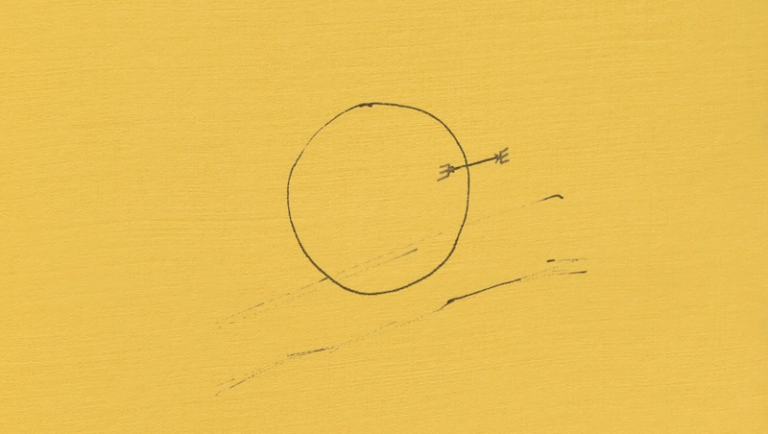
Multitudinous in form like the artist it commemorates, the text also features never before seen sketches by Adnan. Particular in their appearance, they are not the brightly colored canvases that she has come to be associated with, says Azimi, “but rather something more intimate, idiosyncratic and surprising. Something closer to the word.” It was this intimate, idiosyncrasy that intimidated me when I first encountered The Arab Apocalypse, its “litany of color and horror delineating the destruction of Beirut,” in the words of contributor Quinn Latimer . Being a younger poet, I was resistant to the work and struggled against its “war in the vacant sky,” its unheeded prayers and proliferating multi-colored suns. What could I do with these gaps and markings, I thought, if I could not determine their meaning ? These moments of visceral intelligibility achieve such through an indeterminacy that, if I said Adnan wielded , I suspect she might have disagreed with. She might have asserted that indeterminacy is an un-fixedness that one surrenders to. So when I understood myself as being opposed to the poem, really I was experiencing the onslaught of questions that had likely brought Adnan to both page and canvas. Not merely an inquiry of what is happening, or how we live in the midst of it, but what we might do with the stultifying inventory of empire’s daily violences in the world.
This questioning was also at work in the relationships she formed with other artists. “Anytime there was something going on in the world that I was contending with, I would write to her and she would always have a very clear, but simultaneously surprising, perspective on what that thing was,” Japanese-American poet Brandon Shimoda tells me over Zoom. In fact, I had first encountered Adnan’s work when Shimoda posted fragmented missives shared between the two writers on social media. “I wrote her a love letter,” he tells me, recalling their meeting for the first time in Lebanon in 2009. Within about a week of that, Adnan had responded via email, and so began their storied correspondence. “Dear Brandon,” she writes in one email, “we are between spring and something else, a season with no name…when or where suddenly things gel and make sense and the word beauty is applicable.” Who talks like this, I would ask myself, awestruck by her confounding and elucidating responses. When I jokingly ask Shimoda this same question he offers that she was “the closest approximation of a human being simultaneously a homo-sapien and an element” because of what she wrote, how she wrote, and how she was.
My Center… houses various transmissions from Adnan. Lebanese historian Fawwaz Traboulsi, translated from Arabic by Yasmine Seale, offers a visit to Etel in Paris just one week before she passed. Asking to be recorded almost immediately as Traboulsi arrives, we hear Adnan debate with Nietzsche and quote the Sufis. With filmmaker Lamia Joreige, Etel revisits the drama of a lover she chased to America in 1955. Adnan and Swiss curator, Hans Ulrich Obrist, discuss the value of epiphany and spontaneity in poetry, as well as memory in relation to architecture. To American poet Anne Waldman, Adnan writes “Believe me, the thing that means most really most is love—passion love or friendship, the getting together of a few people a few times for a few hours—and it does make of living a wonderful thing.” Each transcribed voice-recording, interview, and letter provides a different window into what it was like to be in close proximity to such a singular thinker.
But transmissions can be felt far beyond their point of origin. Poet and novelist Aria Aber, who knew of Adnan’s importance to other poets she admired, developed an “obsession” with The Arab Apocalypse in 2019. Then in 2020, during the pandemic, she would spend hours staring at the digital versions of Adnan’s paintings. For Aber, the works offered “a sense of home or bounty when everything else was suffused with death and grief.” Aber’s offering to the bounty of this text reads with traces of Adnan’s distinct mysticism; that same peripheral clarity I have found in poets like Aimé Césaire and Édouard Glissant. Her speaker desires to “go beyond” their life, to “abdicate that other coast, and see the self/ disintegrate, or shimmer.” In that lyricism is an alternative totality that Adnan lived, hinted by the entirety of the quote from which the book takes its title.
Aber notes how Adnan’s rejection of centrality is interesting because she “is a guiding light” and an undeniable part of her “literary and spiritual cosmology.” For Brandon Shimoda, the title’s contradiction is an expression of a thought process and proof of Adnan’s constant changing, while, for Negar Azimi, the title speaks to the ways in which Adnan was an “itinerant soul hailing from another planet, in more ways than one.”
Opening My Center… to its early pages, Etel Adnan speaks again. She looks directly at us and whispers, “If you meet me in the street, don’t be sure it is me,” with all the sincerity and truth of a trickster. Don’t be sure uttered by this text suggests a different mode of looking , as much as it suggests a different kind of being . It is our philosopher-poet playing in opacity, tricking us into recognition—into the chance that we might see ourselves in these pages, amidst her beloved friends. At this seventy-two paged book’s exact center is a cosmic exchange. Her drawings, with their long limbs reaching, tell us:
I Am Yesterday and Today and Tomorrow / said The Sun
And I am You / said The Moon
She is bringing us to the crossroads, beginning again. She is saying I miss you.
Does Etel Adnan deserve wider recognition in mainstream culture?
Comments
No comments yet





Comments
No comments yet — be the first to weigh in 👇
No comments yet. Be the first!