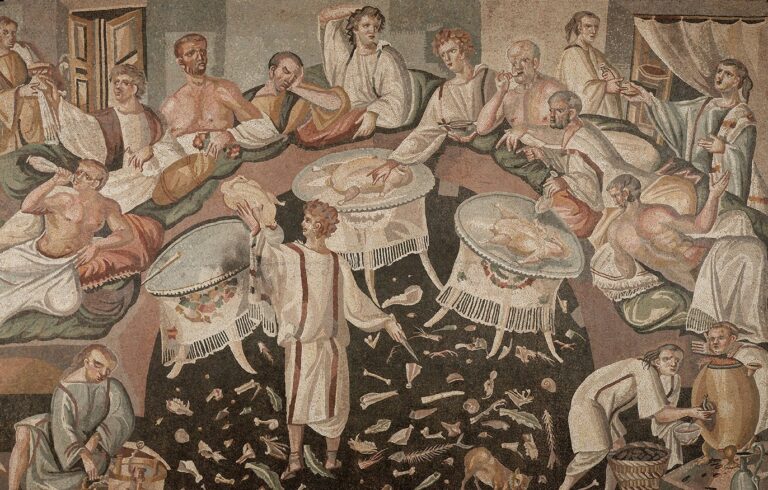
Plato's Symposium is really about love – and dinner parties
The essayist traces a childhood obsession with dinner parties to her adult reading of Plato's Symposium, arguing that the social chaos of a good gathering – divided attention, overlapping conversations, refilled wine glasses – mirrors the philosophical setting in which Plato's dialogue on love unfolds.
Full text
I have been obsessed with dinner parties since I was eight or nine. At this age my greatest desire was to get my mum to let me stay up for the ones she threw for her friends. Once I even succeeded. It was amazing. and yes; it involved a hostess trolley. As an adult I have therefore made it a priority in my life to throw a lot of dinner parties.
The problem with dinner parties, from the point of view of a hostess, is that so much is always going on and once and you can only be in one place at a time. The starter needs plating, you have to check on the main in the oven, one of the guests is being left out of the conversation, another is getting a little too het-up about politics, another still needs a top-up of wine, and you really want to hear what those two over there are saying about your other friend who’s not here, and also where did you leave *your” glass of wine… It’s a problem.
I have also now written a book called The Dinner Party: A Book About Love . It contains a longish poem about a dinner party, also called “The Dinner Party.” As might be expected, this poem describes the sort of dinner party I also throw a lot of.
The problem with dinner parties, from the point of view of a writer, is also that so much is always going on. So many characters, so many dynamics, so many conversations and actions, and they after all going on at the same time. How to catch that spirit, and still keep it comprehensible? And what is it, exactly, that you are trying to catch?
I am being facetious, but I stand by my point: if we look to the Symposium for an orderly or convincing abstract account of what we commonly mean by love then, we will not get it.
When I asked myself this question, the first place I looked for an answer was to probably the most famous piece of writing about a dinner party in western literary history: Plato’s Symposium . Relevantly, this is a literary dinner party that is themed around love. Also relevantly, it is extremely gay.
Accounts of Plato’s symposium have typically focused more on the philosophy of love part than the dinner party part, as if what matters is the content of the various speeches, and not their context. This is even true of George Steiner’s famous essay “Two Suppers,” which so usefully locates the form as being not a dialogue but a genre Steiner calls the “banquet.”
I think this approach is a misapprehension. For one thing most (all?) of the characters have terrible opinions.
One (Aristophanes) maintains (with however amusing a frame) that we are all searching for our one soul-mate. Like, okay twin flames, simmer down. Another (Pausanius) essentially says “Ugh, people who have sex with women are stupid, the only attractive people are approximately-13-year-old boys.” Whilst we can feel sympathy for Pausanius’ historical position as a middle-aged man who was scorned by his contemporaries for still being in the gay relationship he got into as a teenager (and, presumably, therefore for still taking it up the arse) this is not a serious claim. As for Socrates, the wisest, the hero… his speech is the most thrilling, granted, but his final position is that the true goal of love is not having sex or even making a life with the person you adore but (of course) getting really into philosophy instead.
I am being facetious, but I stand by my point: if we look to the Symposium for an orderly or convincing abstract account of what we commonly mean by love then, we will not get it. No, the value of the speeches, if not in intention then certainly in practice, is not to explain love in the abstract, but to offer a convenient means of diagramming the tangle of social relations of attraction and hostility and competition that make up the dinner party.
Each character gets up in turn, casts shade on some people, flirts with others, establishes who they are and how they relate. They tell us their personal metaphysics, granted, but those metaphysics are interesting because they are theirs , not because they are right .
In a normal dinner party everyone would be doing this too (we are all always going around announcing our metaphysics) but simultaneously, in a confusing welter. Plato uses the device of “speech competition” to make the characters themselves insist on talking turns to speak, thus making the party comprehensible without destroying the appearance of naturalism.
What this social diagramming builds to, appropriately, is not a final convincing conclusion to the love discussion, after which everyone can go home possessed of the clarity of philosophical understanding, but instead the interruption of the party by an evil twink with an agenda:
A moment later they heard Alcibiades shouting in the courtyard, very drunk and very loud. He wanted to know where Agathon was, he demanded to see Agathon at once. Actually, he was half-carried into the house by the flute-girl and by some other companions of his, but, at the door, he managed to stand by himself, crowned with a beautiful wreath of violets and ivy and ribbons in his hair.
“Good evening, gentlemen. I’m plastered,” he announced. “May I join your party?
If you know the history of Athens, and the general esteem in which Alcibiades was held, you will know this is a bit like it would be if vengeful drunk twink version of Maréchal Petain suddenly showed up at a dinner with Swann and Odette. It is a true chaos move. But it only works because the dinner party has, up until this point, been constructed in such an orderly fashion, because the social matrix into which Alcibiades is crashing is so clearly established. So it is with all good dinner parties in real life too. They should start in clarity and order, and end in mess.
This is not just any dinner party, it is legendary.
In fact, I would go further still, and argue that the true climax is not even what Alcibiades says, as such, but its aftermath, the way he sets the cat among the pigeons:
Alcibiades’ frankness provoked a lot of laughter, especially since it was obvious that he was still in love with Socrates, who immediately said to him: “You’re perfectly sober after all, Alcibiades. Otherwise you could never have concealed your motive so gracefully: how casually you let it drop, almost like an afterthought, at the very end of your speech! As if the real point of all this has not been simply to make trouble between Agathon and me! You think that I should be in love with you and no one else, while you, and no one else, should be in love with Agathon—well, we were not deceived; we’ve seen through your little satyr play. Agathon, my friend, don’t let him get away with it: let no one come between us!”
Agathon said to Socrates: “I’m beginning to think you’re right; isn’t it proof of that that he literally came between us here on the couch? Why would he do this if he weren’t set on separating us? But he won’t get away with it; I’m coming right over to lie down next to you.”
“Wonderful,” Socrates said. “Come here, on my other side.”
“My god!” cried Alcibiades. “How I suffer in his hands! He kicks me when I’m down; he never lets me go…. It’s the same old story: when Socrates is around, nobody else can get close to a good-looking man…”
This arrangement of bodies, is, I submit, not an abstract but a concrete account of what love is like, and what it is about, which is bodies, particular bodies, and their positioning. It is hilarious and solid and real and vivid and gorgeous. Socrates claims that what we want, what we love, truly, is the move away from particulars and towards the general, the ideal, the good. But that is not where the Symposium goes. On the contrary, it is in the detail of human physical relation that it ends, and it is this, I submit, that we keep reading it for.
I am not suggesting that Plato sat down and wrote the Symposium with an intent to refute Socrates’ views on love, and I don’t want to be a deconstructionist either, to “read the text against itself”. All I am saying is: there is a tension. The form Plato writes in, perhaps invents, of the dinner party with speeches, Steiner’s ‘banquet’ form, pulls against the intellectual content its characters express. Philosophy may be spoken about at a dinner party, but that the content of whatever is said in this line is necessarily belied by the actual fact that the characters, by necessity, are not depicted engaging in the pursuit of wisdom. On the contrary, they are in pursuit of joy.
At the same time, we must concede there is something a little transcendent about the Symposium . Within the diegesis, the story is recounted long after it happened, by people who were children when it occurred. This is not just any dinner party, it is legendary. And then, the artificiality of the Symposium ’s structure, the completeness with which each character lays out their metaphysic, the finality with which the bodies move into place, and above all the unruffledness of Socrates himself, his own capacity to resist exhaustion, all combine to give this party, for all its messiness, a feeling of perfection. Indeed, if I were to imagine perfection, it would not come in any abstracted vision of the good, of truth such as other Platonic dialogues often reach towards, but in the specific form of staying up later than everyone else, intoxicated not only by wine but talk, refusing to quit:
He woke up just as dawn was about to break; the roosters were crowing already. He saw that the others had either left or were asleep on their couches and that only Agathon, Aristophanes, and Socrates were still awake, drinking out of a large cup which they were passing around from left to right. Socrates was talking to them.
He seems like he could go on for ever.
Steiner, in that essay about banquets which I keep mentioning, pairs Socrates with Jesus, the Symposium with the Last Supper. My own trajectory is a little different. I turn instead to a more immanent figure: John Wilmot, the wicked Earl of Rochester, and his poem ‘Timon’.
If the Symposium is a depiction of a good dinner party, so that our feeling afterwards is “God I wish I had been there, I wish I was always,” then Rochester’s ‘Timon’ is a very bad dinner party. We think “I do not want to go there, and in fact get me out.” But we do want to hear about it, as long as it’s from a safe distance.
In fact, more than just an individual bad dinner party, ‘Timon’ is a representative of a whole tradition of bad literary dinner parties: it draws on Boileau’s Satire III, which in turn draws on Horace’s Satire II.VIII. However where Horace, and to a lesser extent Boileau, focus primarily in how bad the food is, Rochester turns the focus firmly to the social elements.
Compare, for instance, the moment in Boileau when it turns out the other promised guests are not going to be there:
À peine etois-je entré, que, ravi de me voir,
Mon homme, en m’embrassant, m’est venu recevoir ;
Et, montrant à mes yeux une allégresse entière,
« Nous n’avons, m’a-t-il dit, ni Lambert ni Molière ;
Mais, puisque je vous vois, je me tiens trop content.
Vous êtes un brave homme ; entrez, on vous attend. »
À ces mots, mais trop tard, reconnoissant ma faute.
[As soon as I arrived, ravished to see me,
Mine host, embracing me, came to receive me;
And, performing for my gaze complete delight
“We have,” he told me, “neither Lambert nor Molière;
But, now I see you, I’m excessively happy.
You’re a brave fellow; come in, we’re all awaiting you.”
At these words, but too late, I recognize my mistake.]
with the same moment in Rochester
But this was not the Worst; when we came home,
He ask’d, “Are Sidley, Buckhurst, Savile come?”
No; but there are above, Halfwit, and Huff,
Kickum, and Dingboy. “Oh! ’tis well enough;
They’re all brave Fellows, cryes mine Host, let’s dine:
I long to have my belly full of Wine.
They will both Write and Fight, I dare assure you;
They’re men tam Marte quam Mercurio .”
I saw my error; but ’twas now too late:
What we gain in Rochester’s version is his unforgiving ear for the stupid and (self-)deceitful things people say. The host’s pretentious Latin tag, his rhyming cliche, his feigned “oh!” of surprise, all these are so vividly social, so animated with disgust. They put before us, not just a plot development, but an interaction, with all its absurd specificity.
What this ear of his allows, along with his cruelty in using it, is a drastic condensation of the Platonic method for depicting a dinner party.
In comes my Lady strait; She had been fair,
Fit to give Love, and to prevent Despair;
But Age, Beauty’s incurable Disease,
Had left her more desire than pow’r to please:
As Cocks will strike, altho their Spurs be gon;
She, with her old blear eyes, to smite begun:
Tho nothing else, she in despight of Time
Preserv’d the affectation of her prime.
How ever you began, she brought in Love;
And hardly from that Subject would remove:
We chanc’d to speak of the French King’s success;
My Lady wonder’d much how Heav’n could bless
A man that lov’d two Women at one time;
But more, how he to them excus’d the crime.
She askd Huff if Love’s flame he never felt:
He answer’d bluntly, “Do you think I’m gelt?”
She, at his plainness, smil’d; then turn’d to me:
“Love, in young minds, precedes ev’n Poetry;
You to that Passion can no Stranger be:
But Wits are given to Inconstancy…”
Here are at least two character’s speeches on love (three if you count the narrator) given in 20 lines. Rochester’s degree of contempt for these people speaks in the concision itself. Huff gets only a single line, but, Rochester implies, that’s enough: that’s really all there is to him.
Another way to say this is that, in place of the extensive self-announcements Plato allows his characters, Rochester substitutes his own summary judgements, his sarcastic imitations. What he gains is a greater degree of naturalism: he is able to outline the dynamics, to cut through the noise and confusion, without resorting to having the characters stand up one by one and make speeches because he places us so firmly inside the point of view of one (extremely sarcastic) speaker. What he loses is a certain objectivity.
There is an irony here: in Plato’s more schematic, abstract arrangement, in which each character explains their ideas at length, what we end up getting is not a philosophical argument but a deeply convincing and moving spreading-out of the intricacies of the social involvement of a group of people with each other. In Rochester, by contrast, amidst a naturalistic welter of satirical details and overlapping conversations, what we get is something much more like an argument about human nature. He is making a point at us, providing evidence, and the point is, as he would later develop it, that:
Were I (who to my cost already am
One of those strange prodigious Creatures, Man)
A Spirit free to choose for my own share,
What case of flesh and blood I’d please to wear,
I’d be a Dog, a Monkey, or a Bear.
Or any thing but that vain Animal
Who boasts so much of being Rational.
In this passage from ‘A Satire Upon Reason and Mankind’ we see in miniature what is perhaps the key development in all of Rochester’s work – a turn from contempt for others to self-contempt.
Although he seems at first view frivolous, it is possible to view Rochester as a sacramental figure, one who underwent an ordeal. If I were making a strong case, I might say I do not know of any other writer who hated themself like Rochester learned to hate himself. He hated himself, not in the modern “woe is me” sense, or in the religious “compared to god we are all sinners” sense either, but analytically and specifically: having looked at his life and the things he did he judged himself to be a bad person who had done bad things and did not forgive himself for it:
I’ve Outswill’d Bacchus, sworn of my own make
Oaths wou’d Fright Furyes and make Pluto quake:
I’ve swiv’d° more Whores, more ways then Sodoms Walls
E’re knew, or th’ Colledge of Romes Cardinals….
Frighted at my own Mischiefs I have fled,
And bravely left my Life’s Defender dead:
Broke Houses to break Chastity, and dy’d
That Floor with Murther which my Lust deny’d;
Pox on’t, why do I speak of these poor Things?
I’ve Blasphem’d my God, and libell’d Kings.
‘Timon’, I am fairly sure, is from before all this. It opens with Rochester’s interlocutor asking “What, Timon, does old Age, begin t’approach?” but this implies that he is, or should be, still young. And contextually it is clearly from a time from when Rochester was still full of his own brilliance, still industriously doing his bad deeds, a time in which his capacity for contempt was still primarily directed outwards. But it is nevertheless a depiction of a person suffering, of a pursuit of joy gone horribly wrong and, as his friend’s observation tells, us, all this being a man is costing him something.
When I came to my own ‘Dinner Party’, I had in mind these two models of particularity: the model of the schematic diagram of a social set, and the model of the person undergoing the ordeal of other people. What is at stake in the choice, or balance, between these is the sense of time passing.
The Symposium , for all its specificity, has a feeling of timelessness about it. These characters, these arrangements, are not changing. Everyone announces themselves but no-one becomes different. To attend this dinner party would be to never die. In Timon, by contrast, everything is a rush, everything is broke-off and confused, everything is hurtling through suffering towards oblivion. Both of these, notably, are feelings I have often had at many dinner parties.
What I tried to do was to have my cake and eat it, to put a narrator like Timon in a narrative structure like that of the Symposium . By containing both these impulses, the one towards persistence, the other towards destruction, I hoped to find a way to write about how the bonds between people can keep surviving and overcoming the forces that pull us apart: to resist both Socrates’ idealism and Rochester’s cynicism.
My previous book, The Call-Out , was, in however comic a register, about destructiveness, about the ways marginalised communities can tear themselves apart. It ends, however, with a character asserting that her community had survived the events of the book, and that they’re “all still here, still ready to love.” She is certainly not right, exactly, but it was this sense of love, of love as whatever impulse brings people together in a time and place, that I wanted to write about in more detail. It is an understanding of love which definitely includes as one of its forms the very desire to throw dinner parties:
The ’Rona being now at last abated
(Or so I thought, in fact the plague was not
Quite gone, but biding time) I went and got
It in my head that by this point I’d waited
For long enough, and that I should invite
Some friends, acquaintances, and even one
Or two newfound unknowns who seemed like fun
To come around my house one Friday night,
Where I would open for them fancy wine
(That they would drink but not appreciate)
And see what kind of food I could create,
And generally, in short, we all would dine
Together, as we had in days gone by…
This essay has been, as you may have noticed, gently ghosting George Steiner’s essay ‘Two Suppers’ . My epigraph is the assertion Steiner makes at the start of his essay: that “the sharing of food and drink… reaches into the inmost of the socio-cultural condition.” This is not, I think an assertion Steiner makes good on. Instead his conclusion reaches for “the problem of the final sources of the poetic-philosophic.” Steiner’s method of reading his suppers is to make them bigger, seeing them as historic, emblematic, symbolic, eventually allegorical.
But I think the joy of the Symposium is not that it tells us some abstract idea about love but that tells us a lot of very real things about what it was like to get trashed and flirt with a bunch of gay guys in classical Athens. I think the joy of ‘Timon’ is that it shows us how a Restoration London dinner party could actually get so bad it made you want to destroy yourself completely. In much the same way, if I am writing about transsexuals having dinner and kissing and holding it together in New York in 2021, it is because that is what I care about, and that is what I want to try to find some way to hold on to.
The epigraph to my “book about love” is from the Symposium , from Socrates’ account of his conversation with Diotima:
“In a word then, love is wanting to possess the good forever.”
“That’s very true,” I said.
“This, then is the object of love,” she said.
“Now, how do lovers pursue it?”
Love is wanting to possess the good forever. Fine, I buy it. It’s an impossible aim, but that is how it is. But the real question is not what love is, nor what its sources are. The real question is: how is it pursued?
__________________________________
The Dinner Party by Cat Fitzpatrick is available from Seven Stories Press.
Comments
No comments yet














Comments
No comments yet — be the first to weigh in 👇
No comments yet. Be the first!