Full text
Near the beginning of his long narrative poem “Letter to Lord Byron,” W. H. Auden writes, “I want a form that’s large enough to swim in.” So too, apparently, did Herman Melville for his sixth book, when the thirty-year-old author decided to enlarge and deepen a relatively straight-forward nautical adventure story, somewhat in the vein of his first and greatest success, Typee: A Peep at Polynesian Life (1846), and make it…what exactly?
Many readers today regard Moby-Dick: Or the Whale (1851) as “the Great American Novel,” yet it has long seemed more than just a work of fiction. Its rhetorical grandeur, frequent metaphysical ruminations, and titanic protagonist—the tormented, vengeance-obsessed Captain Ahab—raise this global hunt for a gigantic white whale to the level of Homeric epic, Shakespearean tragedy, or even Old Testament history, not to overlook its numerous touches of Gothic mystery. At the same time, the book provides a detailed summa and guide to nineteenth-century whaling as well as the intermittent depiction of friendship, indeed love, between its narrator, the ex-schoolmaster who calls himself Ishmael, and a tattooed former cannibal, the harpooner Queequeg. As a consequence of its sheer polyphonic complexity, Moby-Dick thwarts simple interpretation. To this day, nearly every aspect of this masterpiece remains ambiguous, alluringly unsettled.
Critical unsettledness, however, ranks high among the characteristics needed by any viable candidate for the Great American Novel. Perfection, after all, can be a living death. Other essential qualities include a substantial heft, range, and engagement with the United States’s history, especially the recurrent issues of racial injustice, religious enthusiasm, social conformity, and rampant capitalism. Moby-Dick checks all these boxes, as well as that of the overriding American malaise: loneliness. As Melville writes, Ishmael, Ahab, and all the crewmembers of the Pequod are, in some sense, “isolatoes.”
Moby-Dick thwarts simple interpretation. To this day, nearly every aspect of this masterpiece remains ambiguous, alluringly unsettled.
Stylistically, this encyclopedic catch-all of genres readily segues from sermons and soliloquies to thrilling action sequences and anguished cris de coeur. Its first 20 chapters—out of 135—are even slyly comic. The famous opening sentence “Call me Ishmael” sets up the narrator as a proud, Byronic outsider. The Old Testament Ishmael was “a wild man,” with all the world against him. Yet what does this modern wild man dream of doing when feeling a “damp, drizzly November in my soul”? He wants to knock off gentlemen’s hats like some tipsy member of P. G. Wodehouse’s Drones Club. While Ishmael may pause before coffin-warehouses—coffins, of all sorts, become a major leitmotif of the novel—or even talk of committing suicide, his tone is wry, even ironic. There’s little sense of serious melancholy or that he is about to recount harrowing experiences that would leave most of us scarred for life. Nearly the only ominous note arises in his daydream about a procession of whales surrounding “one grand hooded phantom, like a snow hill in the air.”
While en route to ship out on a Nantucket whaler, Ishmael spends a night at New Bedford’s Spouter-Inn, a night which quickly takes on the semblance of stage farce. After humorously describing his contortions as he tries to sleep on a chair, Ishmael reluctantly agrees to the landlord’s suggestion about sharing a bed with another man, only to discover—late at night, in the darkened room—that his companion is a tattooed cannibal who has passed the evening trying to sell a shrunken head. Yes, there are deeper meanings to be found in these pages, but their surface is nonetheless basically comic. That’s true too of the Mutt-and-Jeff arguments between Captain Peleg and Captain Bildad, two Quaker ship-owners whose belief in non-violence doesn’t preclude the bloody slaughter of whales. Bildad regularly repeats to himself lines from the Bible, notably the Sermon on the Mount’s advice against laying up treasures on this earth, but he quickly sets aside any religious scruples about signing the pagan Queequeg when he sees the cannibal’s skill with a harpoon.
But all smiling stops when the Pequod slips away from Nantucket on Christmas Day: Ishmael fades into the background, events grow increasingly portentous, and dire omens proliferate. As Melville later wrote in The Confidence-Man: His Masquerade (1857), “it is with fiction as with religion: It should present another world,” adding “and yet one to which we feel the tie.” Some of Moby-Dick ’s symbolism is obvious. The ship’s official harpooners belong to three different dark-skinned races: Queequeg, the noble South Seas islander; Dagoo, the tall black African; and Tashtego, the sharp-eyed New England “Indian.” The remaining crew members—around 30—are Malaysian, Chinese, Sicilian, Irish, Manx, French, Spanish, English, Danish, and Portuguese, among other nationalities. At a key moment in the novel, we even learn of a Zoroastrian, fire-worshipping Parsee named Fedallah, Captain Ahab’s personal harpooner and Mephistophelian shadow-self, the projection of his inner demons.
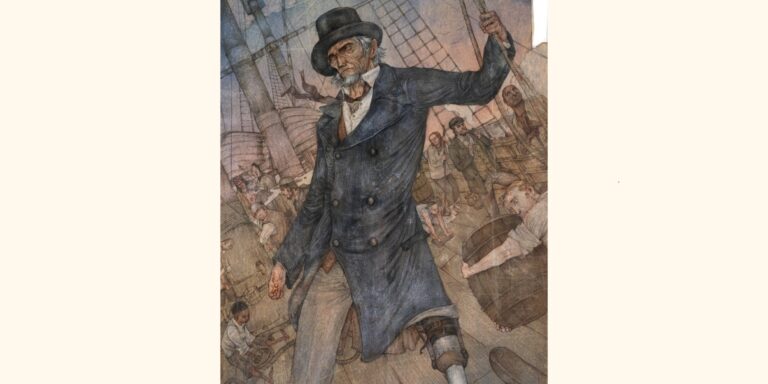
Captain Ahab is, of course, the volcanic figure who transforms the Pequod ’s voyage into something truly rich and strange. From the first mention of his name, he casts a spell on the reader, as he does on the members of his crew. As Captain Bildad tells Ishmael, “He’s a grand, ungodly, god-like man, Captain Ahab; doesn’t speak much; but when he does speak, then you may well listen. Mark ye, be forewarned; Ahab’s above the common; Ahab’s been in colleges, as well as ’mong the cannibals; been used to deeper wonders than the waves; fixed his fiery lance in mightier, stranger foes than whales.” What, one wonders, are those “mightier, stranger foes than whales”? Ahab also bears a scar, “a slender rod-like mark, lividly whitish,” that is said to run from his crown to his sole. It is hard not to think it the mark of Cain.
On a previous voyage, the captain—who is in his late fifties, with a young wife and child—pursued the gigantic, unnaturally white sperm whale known to mariners as Moby Dick. That disastrous encounter resulted in Ahab’s leg being bitten off at the knee—he now wears a whale ivory prosthesis—and there are later hints of sexual impotence as well. Yet instead of retiring from the sea, he pledges to revenge himself by hunting down Moby Dick. What could be more American than this mania, this implacable drive that will brook no opposition? Questioning, if not rejecting, established Christian doctrine, Ahab also comes to regard Moby Dick as the outward and visible sign, the physical embodiment of the indifference or, worse, utter malignity inherent in the universe. The world simply isn’t what it seems. As Ahab tells his sturdy but staid first mate Starbuck:
All visible objects, man, are but as pasteboard masks. But in each event—in the living act, the undoubted deed—there, some unknown but still reasoning thing puts forth the mouldings of its features from behind the unreasoning mask. If man will strike, strike through the mask! How can the prisoner reach outside except by thrusting through the wall? To me, the white whale is that wall, shoved near to me. Sometimes I think there’s naught beyond. But ’tis enough. He tasks me; he heaps me; I see in him outrageous strength, with an inscrutable malice sinewing it. That inscrutable thing is chiefly what I hate; and be the white whale agent, or be the white whale principal, I will wreak that hate upon him.
These ardent vows notwithstanding, the riven Ahab periodically yearns for the peace and comforts of home while viewing such tender, human feelings as weakness. When the Pequod sails smoothly through placid waters, he feels the resulting serenity as a temptation to be resisted. He thrives instead on typhoons. As D. H. Lawrence said of him, “Some souls are purgatorial by destiny.”
When Ahab first speaks to the crew about Moby Dick, his diabolical charisma soon infects the men who, apart from Starbuck, enthusiastically join him in his monomaniacal crusade. Later, he performs a satanic ritual as he “baptizes” a special-made harpoon blade in human blood while deliriously howling, “ Ego non baptizo te in nomine patris, sed in nomine diaboli! ” Meanwhile, Fedallah, who is never seen to eat or sleep, grows increasingly uncanny, sliding about noiselessly like “a tremulous shadow cast upon the deck by some unseen being’s body” yet somehow hypnotically linked to Ahab. One critic has gone so far as to call Moby-Dick a study in demonology.
Other scholars, however, downplay the book’s diablerie , viewing the Pequod ’s captain instead as an admirably heroic overreacher or a latter-day Prometheus facing down the gods, fate, the uncaring universe. Moby Dick himself is nearly as multivalent. “The front of the Sperm Whale’s head,” Melville writes, “is a dead, blind wall, without a single organ or tender prominence of any sort whatsoever.” Add the whale’s whiteness and you are left with a creature that is a visual tabula rasa upon which any interpretation can be written. Is he an innocent creature hounded by human predators? Or should we see in him an unfathomable “indefiniteness,” emblematic of “the heartless voids and immensities of the universe”?
In contrast, Moby-Dick the novel is anything but empty or blank. It constantly addresses the reader directly and shows the influence—and sometimes near plagiaristic borrowings—from some 160 known books (Shakespeare’s King Lear and Macbeth , the Bible, and whaling histories predominantly). Melville’s many info-dumps—particularly the chapters devoted to the minutiae of cetology and the detailed description of how blubber is rendered into oil—appear to function, in part, as factual ballast to the novel’s more heavyweight Wagnerian scenes or its several cinematic accounts of actual lowerings in pursuit of these great leviathans.
It’s important to remember that whale oil was an expensive commodity in the first half of the nineteenth century, its marketing dominated by New Englanders. Nonetheless, killing such huge creatures was exceptionally risky—and not just for the oarsmen and harpooners in the boats. One in three New Bedford whaling ships would eventually be lost at sea. Most famously, the Essex was rammed by a whale with tragic consequences. (See Nathaniel Philbrick’s In the Heart of the Sea for an award-winning account of what happened.) Melville knew about the Essex , as he knew stories about an actual white whale called Mocha Dick. Useful as both were to galvanize his imagination, the Pequod would sail in deeper waters. Even a chapter about something as mundane as the line attached to a harpoon can quickly morph into an unforgettable reflection on mortality:
All men live enveloped in whale-lines. All are born with halters round their necks; but it is only when caught in the swift, sudden turn of death, that mortals realize the silent, subtle, ever-present perils of life. And if you be a philosopher, though seated in the whale boat, you would not at heart feel one whit more of terror, than though seated before your evening fire with a poker, and not a harpoon, by your side.
Let me add that Melville being Melville makes the first half of that paragraph do double duty: it precisely describes how one character will die later on in the book.
Today, we instinctively tend to view whales with sympathy, as magnificent creatures of beauty and sublime power and, all too often, the victims of overfishing and capitalist greed. Melville manifests some of these same feelings. In “The Grand Armada” chapter he depicts a huge pod of whales as a loving family, circling its young for their protection, fearful of the ship and boats that bring pain and death. When the third-mate Flask kills an old blind whale lacking one fin, there follows this acid comment: “For all his old age, and his one arm, and his blind eyes, he must die the death and be murdered, in order to light the gay bridals and other merry-makings of men, and also to illuminate the solemn churches that preach unconditional inoffensiveness by all to all.”
Such sympathy seems quite modern, but so do some of the novel’s other elements, most notably the depiction of same-sex, interracial love between Ishmael and Queequeg. Nothing is ever explicit, but the innuendo is there from the beginning. When Ishmael awakes after his first night at the Spouter-Inn, he recalls that “I found Queequeg’s arm thrown over me in the most loving and affectionate manner. You had almost thought I had been his wife.” This comfortable intimacy deepens when the two men weave a mat together and then widens to embrace all humanity, albeit with a sexual undertone, in the Walt Whitman-like chapter “A Squeeze of the Hand”: “Let us squeeze hands all round; nay, let us all squeeze ourselves into each other; let us squeeze ourselves universally into the very milk and sperm of kindness.” In the end, Ishmael’s life is saved because he can wrap his arms around Queequeg, if only metaphorically, when he clings to the harpooner’s coffin, repurposed as a life raft.
We know from letters that Melville thought he was essentially finished with writing Moby-Dick in August 1850. That month, though, he read and was overwhelmed by Nathaniel Hawthorne’s collection of short stories, Mosses from an Old Manse , then shortly afterward met the author himself. Inspired by Hawthorne’s example, Melville devoted the next year to reworking, indeed supersizing his book—which he would dedicate to his new friend—so that it would resemble something closer to “a democratic tragedy of Shakespearean heft.” In the end, its prose, especially when Ahab speaks, would achieve an oratorical splendor that can still shake our very souls:
What is it, what nameless, inscrutable, unearthly thing is it; what cozening, hidden lord and master, and cruel, remorseless emperor commands me; that against all natural lovings and longings, I so keep pushing, and crowding, and jamming myself on all the time; recklessly making me ready to do what in my own proper, natural heart, I durst not so much as dare? Is Ahab, Ahab? Is it I, God, or who, that lifts this arm?…By heaven, man, we are turned round and round in this world, like yonder windlass, and Fate is the handspike.
After Moby-Dick , Melville would go on to publish three more novels, Pierre: Or the Ambiguities (1852), Israel Potter: His Fifty Years of Exile (1855) and The Confidence Man: His Masquerade (1857) as well as a dozen or so short stories, including “Bartleby the Scrivener” about the little clerk who rebels by repeatedly insisting, “I would prefer not to.” By his late thirties, though, Melville’s career as a fiction writer was essentially over. Until his death at age seventy-two in 1891, he composed poetry, worked as a customs inspector in New York, and left behind the manuscript of a heart-wrenching novella, Billy Budd (1924). But mostly Melville was forgotten, though less so in England than America. He foresaw such a fate early on. As he said in a letter, “Though I wrote the Gospels in this century, I should die in the gutter.”
Yet sometimes there are resurrections. By the 1920s, Melville was again being read, studied, written about. T. E. Lawrence declared that he wanted Seven Pillars of Wisdom to be a “titanic” book like The Brothers Karamazov , Thus Spake Zarathustra , War and Peace or Moby-Dick . By the 1950s Melville’s star had not only risen again, it was on its way to becoming a supernova, with no sign that it has yet lost any of its radiance.
Paradoxically, though, the book’s emergence as “the Great American Novel” may have inhibited its enjoyment by ordinary men and women, left them daunted by its reputation. Yet Moby-Dick should be read, not just revered or studied in school. This Folio edition, sumptuously produced, beautifully illustrated, allows you to experience this masterpiece directly, unencumbered by critical apparatus. Someday, you may want to seek out the innumerable scholarly commentaries or the several Melville biographies. But only later. For now, shipmates, turn instead to that immortal opening and begin the voyage: “Call me Ishmael.”
____________________________
From Moby-Dick , The Folio Society. “Introduction by Michael Dirda for The Folio Society’s Limited Edition of Moby-Dick .” Illustrations © Mu Pan 2026.

















Comments
No comments yet — be the first to weigh in 👇
No comments yet. Be the first!