
Ukrainian strikes on energy infrastructure trigger acute fuel crisis across Russia
Ukrainian missile and drone strikes on Russian energy infrastructure have triggered a fuel crisis affecting two-thirds of Russia's 83 regions, disrupting millions of citizens and threatening many businesses. Crimea has been hit hardest, with authorities declaring a state of emergency and banning all fuel sales, while the peninsula's vital tourism industry has collapsed. For the first time in four years of war, Putin was forced to publicly acknowledge the economic impact, summoning top officials to Moscow to address the crisis.
Full text
For four years, Russian President Vladimir Putin has largely managed to shield the population from the economic consequences of his war in Ukraine. No more.
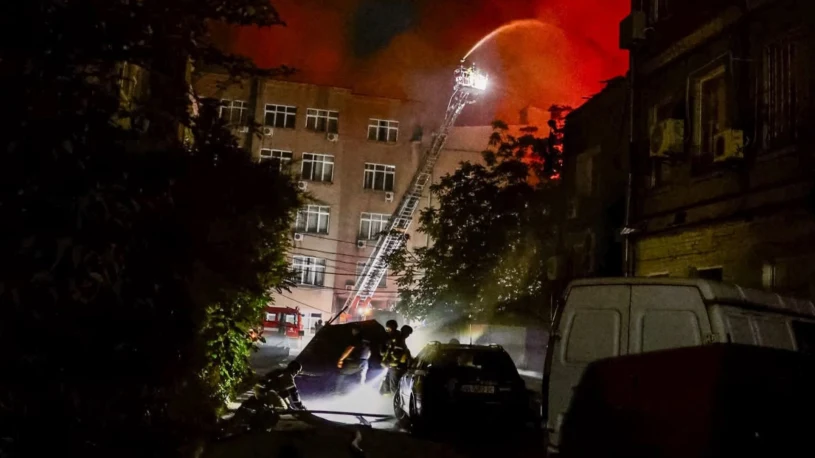
The Ukrainian missile and drone strikes on key energy infrastructure in recent weeks has turned the war from a relatively minor irritant that most Russians could ignore into an immediate and increasingly acute fuel crisis.
Two-thirds of Russia’s 83 regions are now reporting problems with fuel supply , an immediate inconvenience to millions and an equally immediate threat to the viability of many businesses.
The situation is particularly acute in Crimea, where the authorities have declared a state of emergency and banned all fuel sales. Tourism, key to the peninsula’s economy in a normal year, has collapsed .
Putin was forced to acknowledge the problem last week, summoning his top officials to Moscow to work out a fix.
In public, he puts a sanguine spin on the crisis. He told state media that “of course, these strikes on our infrastructure facilities create problems. That’s obvious” but insisted that “a certain deficit” of fuel was not “critical.” He then quickly moved on to claim that Russian strikes were hurting Ukraine much more.
Russia’s President Vladimir Putin addresses the 23rd Congress of the United Russia party in Moscow on June 28 where he vowed to ensure security and overcome challenges as Ukraine stepped up its retaliatory strikes inside Russia. | Yekaterina Shtukina/POOL/AFP via Getty Images
As far as hard numbers go, the scale of the damage is being disguised, with Russia adding domestic fuel prices to the list of economic data that it no longer publishes.
Plenty of Russians, however, are finding out for themselves just how bad things are. Social media are exploding with footage of drivers attacking each other over gasoline at filling stations, or even rampaging in trucks through queues of cars waiting to fill up.
It’s gotten to the stage where the nation that the late Sen. John McCain derided as “a gas station masquerading as a country” isn’t even a gas station any more: Reuters reported on Wednesday that India — the biggest foreign buyer of Russian crude oil — will now export some of what it refines back to its country of origin.
Those imports are needed because — according to some Russian social media accounts — Ukraine has deliberately targeted refinery units such as catalytic crackers that Russia can’t repair or replace itself, meaning that there is no quick end in sight to fuel shortages. Catalytic crackers help to maximize the yield of commercially useful distillates from crude oil.
“The amount of gasoline available in Russia at the moment is determined by a race between Ukrainian drones and Russian repair teams” Sergey Vakulenko, an analyst with the Carnegie Institute for International Peace, wrote in a research note . “If the frequency of Ukrainian attacks can be maintained, and the damage from each attack increases, then the advantage swings toward Kyiv. That’s what we are currently seeing.”
The one silver lining for the Kremlin is that the country still has plenty of diesel, essential for trucks and for agricultural machinery. However, officials said after the weekend meeting that the government may yet impose a ban on exports later this summer to guarantee supply around the harvest searson. It has already banned exports of jet fuel and gasoline.
Putin with Sberbank CEO German Gref at an exhibition of the AI Journey international AI conference in Moscow in November 2025. | Kristina Kormilitsyna/POOL/AFP via Getty Images
How much?
Even when fuel is available, there is the issue of rising prices.
Fuel prices typically have a big impact on broader inflation, and the Central Bank of Russia warned in the minutes of its latest policy meeting on Wednesday that the recent surge is more likely to have a lasting impact than would have been the case in the past.
An existing government agreement on price restraint with the major oil companies may help keep official prices down, but anecdotal evidence points to a rise in unofficial fuel sales at hefty markups, which businesses can’t help but pass on to their customers. The trend “creates additional inflationary risks,” the bank said.
Such considerations were a key factor in the bank’s decision to cut its key rate by only a quarter point in June to 14.25 percent, at a time when businessmen and many in the government were clamoring for more.
The caution of Central Bank Governor Elvira Nabiullina has earned her plenty of enemies over the last four years, during which she had to raise interest rates to 23 percent to stop the economy from overheating. Now that headline inflation has slowed to around 5 percent, many accuse her of needlessly dragging her feet.
German Gref, chief executive of Russia’s largest retail bank, Sberbank told his shareholder meeting on Tuesday that the economy has now cooled more than enough and that the central bank needs to bring rates down faster. The two clashed in a panel discussion at a conference in Moscow on Wednesday.
Russian Central Bank chair Elvira Nabiullina at the State Duma in Moscow on March 24, 2026. | Contributor/Getty Images
Nabiullina said she was “categorically against” faster rate cuts, saying that such an “experiment on our own country” would lead to a sharp rise in inflation, or even stagflation.
“Let’s just see,” an evidently unpersuaded Gref replied, to laughter from the audience.
The exchange is notable because Gref was for many years Nabiullina’s boss at the economy ministry, and the two have both acted as a counterweight to the brasher members of a government still largely informed by the philosophy of Soviet-era spies.
But in one key respect, Gref and Nabiullina remain on the same page. Both have been bold enough to link the war directly to the mounting economic problems that Russians are facing now.
“I think we are all worried about the same thing,” Gref said on Tuesday. “I don’t think there is a person in the country who has any other concerns than the speedy end of hostilities. This is obvious.”
For her part, Nabiullina had reportedly tendered her resignation within weeks of the invasion due to deep misgivings about it, only for Putin to refuse.
Since then, with a central banker’s caution, she has restrained herself to warning that the budget — and the widening gap between spending and tax revenues — risks stoking inflation further. But she has pushed that line with increasing urgency over the last year, as Russia has burned through its reserves and relied increasingly on borrowing to finance the war.
After a huge increase in the first half of 2026, military and classified spending now accounts for almost half of the government total, according to Janis Kluge , an analyst with the German Institute for International and Security Affairs. Liquid assets in the National Welfare Fund, which was originally set up to cushion the economy against swings in the oil price, have meanwhile fallen from around 7 percent of gross domestic product in early 2022 to only 1.7 percent of gross domestic product as of April.
In other words, it isn’t just Putin’s fuel supply that’s running short.
Will Ukraine's strikes on Russian energy infrastructure help end the war sooner?
Comments
No comments yet













Comments
No comments yet — be the first to weigh in 👇
No comments yet. Be the first!