Full text
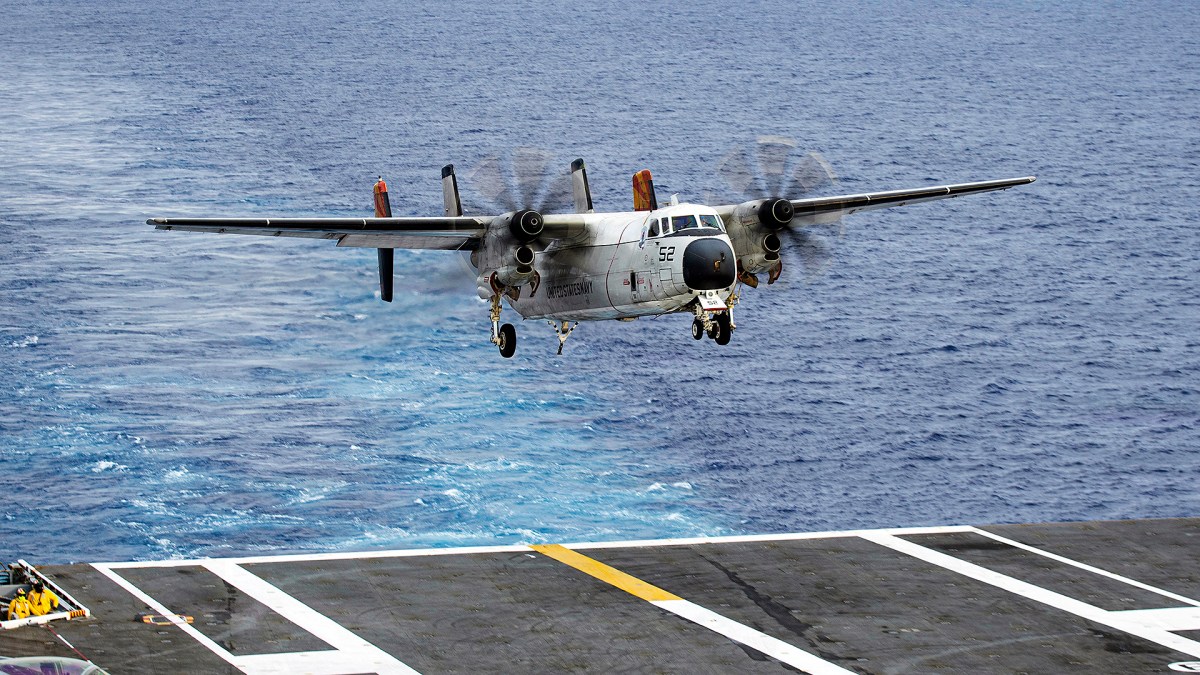
The venerable C-2A Greyhound carrier onboard delivery (COD) aircraft made its final flight to an aircraft carrier, a U.S. Navy official confirmed to TWZ . This final trap, which took place last week aboard the USS Nimitz , marks the end of nearly 60 years of providing logistics services to America’s flattops. That role has now been completely turned over to the Navy’s fleet of CMV-22B Osprey tiltrotor aircraft , the official told us, marking the end of an era in naval aviation.
On June 25, Greyhounds belonging to the “Rawhides” of Fleet Logistics Support Squadron 40 made the last arrested landing and catapult launch from a carrier, the official added. Though the Greyhounds won’t land on carriers anymore, they will still be flying until later this year when they are anticipated to be fully retired, barring any major contingencies.
You can read more about what it was like to fly a Greyhound in our deep-dive interview with a former pilot here .
A C-2A Greyhound, attached to the “Rawhides” of Fleet Logistics Support Squadron 40, takes off from the flight deck of the Nimitz class aircraft carrier USS Nimitz (CVN 68), making the last ever catapult launch of a Greyhound on June 25, 2026. (U.S. Navy photo by Mass Communication Specialist 2nd Class Peter K. McHaddad)
Janes was the first to report the last carrier mission of the Greyhound.
“Vice Admiral Doug Perry, commander of both the Joint Force Command Norfolk and the US 2nd Fleet, joined Nimitz as the ship travelled north from Mayport, Florida, toward New York City,” the publication stated. “Adm. Perry and several reporters, including Janes , boarded the Greyhounds as the C-2s were catapulted off Nimitz at about 1800 local time, marking the aircraft’s final expected COD takeoff.”
Greyhounds were aboard the Nimitz along with the T-1 demonstrator for the MQ-25 Stingray unmanned tanker program and a number of Super Hornets, all of which are taking part in a large multinational exercise associated with America’s 250th birthday. The C-2s on the other hand didn’t linger around.
The Greyhound, a derivative of the Navy’s E-2 Hawkeye airborne early warning and control aircraft, first entered service in the late 1960s and replaced the piston-engined C-1 Trader in the COD role.
An E-2D Hawkeye, assigned to Airborne Command & Control Squadron (VAW) 117, flies over the Nimitz class aircraft carrier USS Abraham Lincoln (CVN 72). (U.S. Navy photo by Mass Communication Specialist Seaman Apprentice Daniel Kimmelman) Seaman Daniel Kimmelman
“The original C-2A aircraft were overhauled to extend their operational life in 1973,” the U.S. Naval Academy noted . “In 1984, a contract was awarded for 39 new C-2A aircraft to replace the earlier airframes. Dubbed the Reprocured C-2A due to the similarity to the original aircraft, the new C-2A includes substantial airframe and avionic systems improvements. All the older C-2As were phased out in 1987, and the last of the new models was delivered in 1990.”
Greyhound’s replacement, the CMV-22B, was declared Initial Operational Capability (IOC) in 2021 . While the Program of Record has 48 CMV-22Bs projected, the Navy currently plans to procure only 44 aircraft.
A CMV-22B Osprey hovering. (Petty Officer 3rd Class Derek Kelley) Petty Officer 3rd Class Derek Kelley
As we noted in previous coverage , the advent of the Ospreys was seen as a “game-changer” by senior Navy officials.
“With distributed maritime ops, longer ranges, distances between multi-carrier operations, distances from land-based areas, and the ability for the CMV-22B to plop down on unimproved spaces, it proved to be a game-changer for us on deployment,” Vice Adm. Kenneth Whitesell, then-commander of Naval Air Forces (NAVAIR) and Naval Air Force, U.S. Pacific Fleet, said during a 2022 Maritime Security Dialogue event .
From our past story :
“ Powered by two Rolls-Royce Liberty AE1107C engines, each delivering 6,200 shaft horsepower, the Osprey has a range of about 1,150 nautical miles with a 6,000-pound internal payload, Whitesell noted at the time. It’s also capable of aerial refueling, while the C-2 is not .
By comparison, the Greyhound , powered by two Allison T56-A-425 turboprop engines each delivering 4,600 shaft horsepower, has a range of about 1,000 nautical miles .
Then there was the issue of being able to land on an aircraft carrier at night.
Whitesell said the CMV-22B can do that, while the Navy has been ‘reticent in the past’ to allow Greyhounds to do night carrier landings ‘based on the avionics in that platform .’”
There are various other advantages and disadvantages of each platform. For instance, the C-2 is pressurized and can fly at higher altitudes, over weather, while the CMV-22 is not and flies at lower altitudes.
Navy CMV-22B Ospreys landing on an aircraft carrier. (U.S. Navy photo by Mass Communication Specialist 3rd Class Emma Burgess)
While the Navy was moving to retire the Greyhounds, the Ospreys encountered a number of problems. Key among them was a three-month-long grounding of virtually all Osprey tiltrotors worldwide following the fatal crash of a U.S. Air Force CV-22B off the coast of Japan in 2023 .
The 2023 CV-22 crash “was definitely a wake-up call for many of us who are anticipating transitioning from the C-2 to the CMV-22,” Rear Adm. Douglas ‘V8’ Verissimo, then commander of Naval Air Force Atlantic (AIRLANT), said bluntly last year . “The C-2 crews, with some venerable old aircraft, stepped up and took care of business. An unexpected surge in the requirement to maintain carrier onboard delivery [COD] to our aircraft carriers going forward.”
A C-2A Greyhound assigned to the Providers of Fleet Logistics Support Squadron 30 lands aboard the aircraft carrier USS Nimitz . (U.S. Navy photo by Mass Communication Specialist 3rd Class Peter Merrill)
In the wake of that incident, there were flight restrictions placed on the Ospreys that limited the range they could fly, which impacted their COD role. However, after mechanical fixes were made, the Navy began lifting those restrictions in January, a Navy official told us.
“For security reasons, the specific thresholds, numbers of aircraft affected, and details of added controls are not releasable,” the official added.
There have also been relatively damning reports about the CMV-22’s ability to do the COD mission from the Pentagon’s own testing force, nonetheless less the C-2’s final retirement has drawn closer.
Future and the past: C-2s sit next to the T-1 MQ-25 demonstrator, representing the future on unmanned naval air warfare. (U.S. Navy photo by Mass Communication Specialist Seaman Johnathan McCune) Seaman Johnathan McCune
Regardless of how the CMV-22Bs are still restricted, the Navy apparently feels confident enough in the Osprey to move the C-2A Greyhound one step closer to retirement. At the same time, there can be no doubt that while the Navy gains new capabilities with the Osprey, it loses others with the C-2. Beyond that, the workhorse nature of the C-2 is a known and proven quantity, while the CMV-22 is still having its teething issues.
No matter the aircraft, COD is a ‘no-fail’ mission that enables the entire carrier strike group. With that in mind, the CMV-22 will have some big flight boots to finally fill alone once the C-2 leaves the service later this year.
Contact the author: howard@twz.com
The post The C-2 Greyhound Has Made Its Last Trap Aboard A Carrier appeared first on TWZ .

















Comments
No comments yet — be the first to weigh in 👇
No comments yet. Be the first!